SOC 2 for AI-Enabled SaaS and Managed Services — Assessment Scope and Control Evidence
An existing SaaS service gains an AI-assisted feature. Customer information now passes to a model provider, a new log records prompts, and some outputs require human approval before they affect a customer workflow.
For SOC 2, explain how that change affects the described service, commitments, dependencies and controls. The assessment question is not answered by labelling the product “AI powered.” It needs a clear account of the activities and evidence within the proposed engagement.
This article concerns service-control evidence for an AI-enabled offering. A separate AI management-system requirement should be discussed through the established SCS ISO 42001 service page.
Identify the AI activity inside the service
Describe what the feature does and how its output is used. Identify the service owner, operating team, external providers and important customer commitments. A feature that drafts a response can have different operational implications from one that initiates a transaction.
Map inputs, processing, storage and outputs at a level that explains relevant information flows. Include prompt histories, support records or monitoring data where they affect the described operation. Avoid sending sensitive production prompts through an unrestricted enquiry channel.
Review boundaries and provider responsibilities
A model supplier may operate the underlying model while the service organisation controls integration, customer access, application permissions and use of outputs. Record the actual division and the information available about the supplier's service.
Do not assume that a provider's report covers the integrating application's operation. Equally, do not describe a colocation facility as governing a customer's AI model simply because it hosts equipment. The appropriate boundary depends on what the organisation actually does.
The AICPA Description Criteria resource provides context for management's system description. Explain material AI-related activities as part of the service rather than treating them as a disconnected marketing appendix.
Connect the change to control evidence
|
AI-enabled service activity |
Information to retain |
Assessment question |
|
Feature release |
Purpose, review, tests and authorisation |
What was approved for production? |
|
Model provider change |
Notification, impact review and decision |
What changed in the dependent service? |
|
Customer-data handling |
Flows, permissions, logging and retention |
What information reaches each party? |
|
Human approval |
Responsibility, review record and exceptions |
How did the described check operate? |
|
Output-related incident |
Investigation, customer effect and follow-up |
How was the relevant service issue handled? |
These examples are not a universal AI control catalogue or a claim that each item is required in every SOC 2 engagement. The relevant commitments, criteria and described controls need practitioner evaluation.
Keep model and integration changes visible
Retain the feature version, provider service, relevant configuration and effective dates where they matter to the operating explanation. If a provider changes behaviour or availability, document what management evaluated and decided.
Tests should be related to the service purpose and change being assessed. Explain the conditions, results and limits of a test rather than presenting one successful example as proof of every future output.
NIST's AI Risk Management Framework offers useful contextual guidance for AI risk considerations. It does not turn a SOC 2 report into an assurance opinion on every ethical, safety or performance characteristic of an AI model.
Trace customer information through prompts and logs
Identify what users can submit, what the service transmits, what is retained and who can access it. Compare supplier arrangements and actual application behaviour. Record exceptions and decisions where the intended handling differs from observed practice.
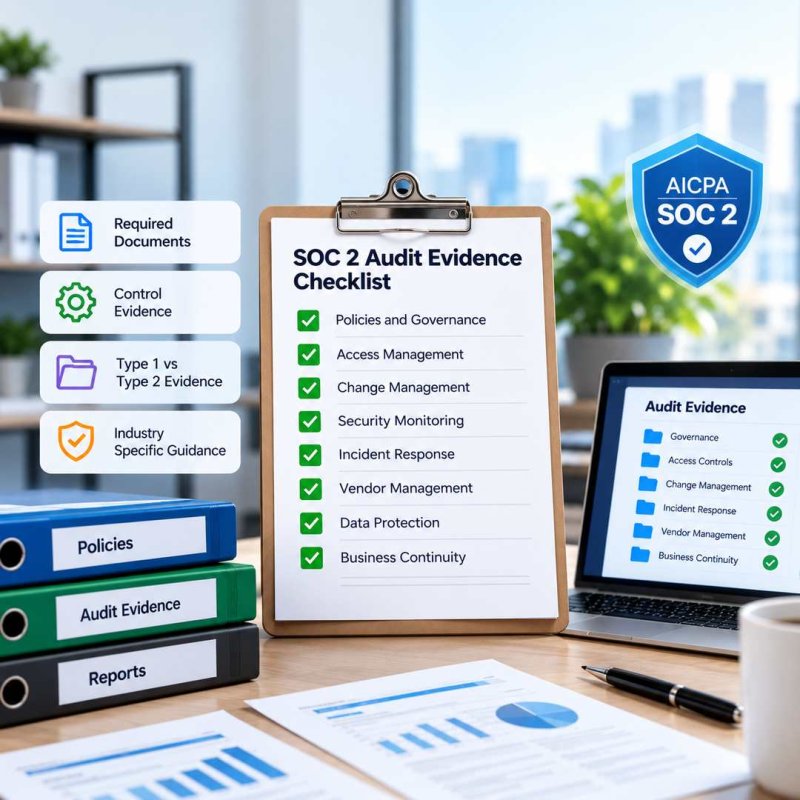
Relevant controls may concern access, confidential information, privacy, changes, availability or processing. Category selection still depends on the actual engagement. Use the SCS evidence checklist to organise records without creating a second generic documentation inventory.
Explain the role of human review
If human approval is described as a control, identify who performs it, what they review, the relevant authority and what record is retained. An optional user warning and a recorded approval step are different operating arrangements.
Where the output supports a customer decision, explain who retains responsibility for that decision and any limits communicated through the service. Do not claim that a reviewer guarantees every output is correct simply because a person is involved.
A fictional AI-assisted support feature
A Malaysian SaaS company adds AI-generated draft replies to its support platform, with development support in India. Staff review drafts before sending them to customers. A provider update changes the draft's handling of account context.
The company records the update, relevant evaluation, approval and deployment decision. It checks prompt/log handling and whether staff-review records support the control it describes. An identified incorrect draft is investigated with its actual effect and response retained.
The example shows a service-evidence question, not a model certification result. The Malaysia and India SOC 2 guides provide wider country context.
Keep supplier due diligence and assurance purposes clear
For the separate task of evaluating a purchased AI supplier, use the existing SCS AI-vendor security and privacy guide. That buyer task differs from describing your own AI-enabled service for examination.
If an enquiry also requests ISO/IEC 42001, clarify both outputs and roles. ISO's official overview describes an AI management system; a SOC 2 report has a different reporting purpose. Neither should be presented as a guarantee that every model output is safe or error-free.
Discuss the proposed AI-enabled service with SCS
Provide the service, AI activity, data-flow summary, provider dependencies, changes and current evidence status. Identify the customer requirement and any existing assurance.
Contact SCS to discuss the proposed scope, requested support and independent examination arrangements. Keep the enquiry tied to actual service responsibilities rather than the presence of AI terminology alone.
Need ISO Certification for Your Business?
Speak with our certification specialists to understand certification requirements, audit process, implementation timelines and accredited certification services.