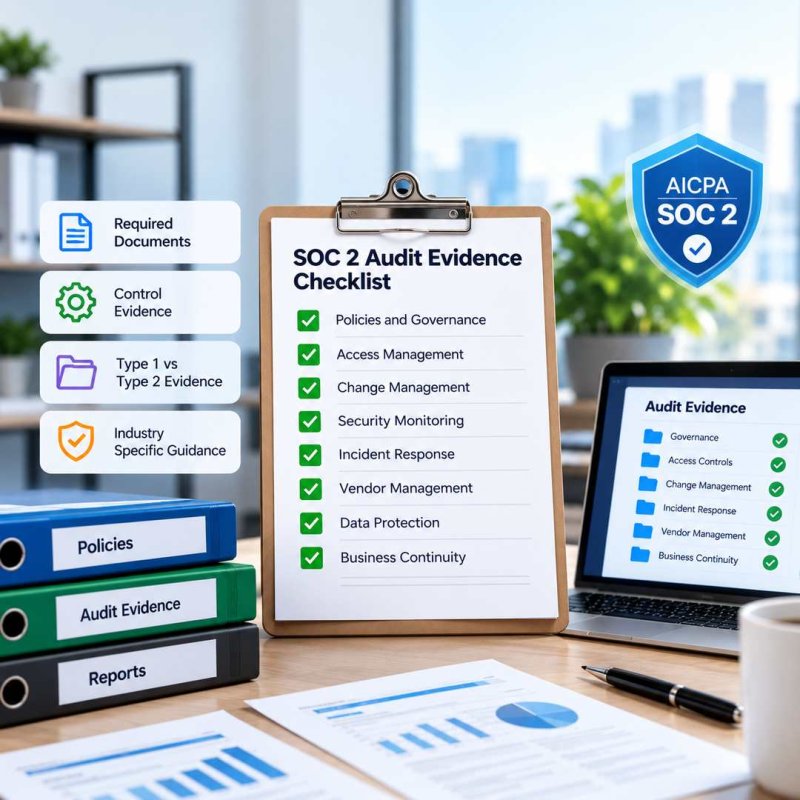
SOC 2 Type 1 vs Type 2: Differences, Scope and Reporting Period
Choosing between SOC 2 Type 1 and Type 2 is an important consideration for SaaS companies, cloud service providers, fintech businesses, managed IT service providers and organizations handling customer information.
Both report types examine controls relevant to the AICPA Trust Services Criteria. However, they differ in their assessment approach, evidence requirements and reporting period.
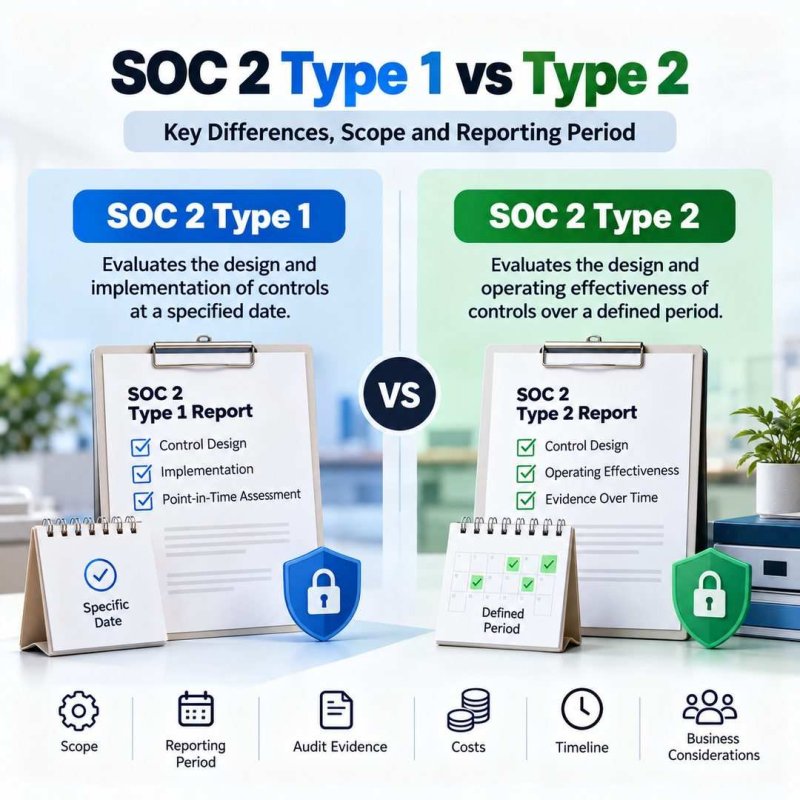
SOC 2 Type 1 evaluates the design and implementation of controls at a specified date. SOC 2 Type 2 evaluates control design and operating effectiveness over a defined period.
Understanding the difference between SOC 2 Type 1 vs Type 2 helps businesses select the appropriate examination, prepare audit evidence, plan reporting timelines and respond to customer security requirements.
This guide explains the differences, reporting periods, audit requirements, evidence, costs, timelines and considerations for choosing between the two SOC 2 report types.
What Is SOC 2?
SOC 2 is an assurance reporting framework developed by the American Institute of Certified Public Accountants (AICPA). It is used to examine controls at service organizations against applicable Trust Services Criteria.
The formal deliverable is a SOC 2 report issued following an examination by an appropriately qualified independent CPA firm.
Although businesses frequently search for SOC 2 certification, SOC 2 compliance certification or SOC 2 audit certification, SOC 2 is not an ISO-style management-system certification. The formal assurance outcome is an examination report.
SOC 2 is relevant to:
-
SaaS and software companies
-
Cloud service providers
-
Fintech and financial technology businesses
-
Managed IT service providers
-
Data-processing organizations
-
Cybersecurity service providers
-
Technology companies serving enterprise customers
-
Businesses managing sensitive customer information
SOC 2 Type 1 vs Type 2: Key Difference
The main difference between SOC 2 Type 1 and Type 2 is what the examination evaluates and when.
SOC 2 Type 1 evaluates whether controls are suitably designed and implemented as of a specified date.
SOC 2 Type 2 evaluates whether controls are suitably designed and operated effectively throughout a defined period.
A Type 1 report provides a point-in-time assessment. A Type 2 report provides evidence about control operation over time.
What Is SOC 2 Type 1?
SOC 2 Type 1 evaluates the design and implementation of relevant controls at a specified date.
The examination may consider whether the organization has established appropriate policies, procedures, responsibilities and technical safeguards for the systems included in scope.
Examples include:
-
Information security policies
-
User access management
-
Privileged account controls
-
Change management procedures
-
Incident response arrangements
-
Risk assessment processes
-
Backup and recovery arrangements
-
Vendor management procedures
A Type 1 report does not establish that controls operated effectively throughout a historical period. It addresses the control environment as of the specified date.
What Is SOC 2 Type 2?
SOC 2 Type 2 evaluates the design of relevant controls and tests their operating effectiveness over a defined examination period.
The examination may involve inspection of records, sampling of transactions, access reviews, change tickets, incident records and other evidence demonstrating how controls operated.
Examples include:
-
Periodic user access reviews
-
Employee onboarding and termination controls
-
Security monitoring records
-
Change approval evidence
-
Vulnerability management activities
-
Incident response records
-
Backup monitoring
-
Vendor reviews
-
Security awareness training
A Type 2 report provides evidence about control operation during the period covered by the examination.
SOC 2 Type 1 vs Type 2 Comparison Table
| Comparison factor | SOC 2 Type 1 | SOC 2 Type 2 |
|---|---|---|
| Main purpose | Evaluate control design and implementation | Evaluate design and operating effectiveness |
| Assessment basis | Specified date | Defined period |
| Operating effectiveness testing | No period-based operating effectiveness test | Includes operating effectiveness testing |
| Evidence | Policies, procedures, configurations and implementation evidence | Design evidence plus records demonstrating operation over time |
| Reporting period | Point in time | Commonly several months |
| Preparation | May be shorter when controls are ready | Requires sustained operation and evidence collection |
| Customer assurance | Shows control arrangements at a date | Shows how controls operated during the period |
| Common use | Initial reporting or specific customer requirements | Ongoing assurance and enterprise due diligence |
| Formal deliverable | SOC 2 Type 1 report | SOC 2 Type 2 report |
The appropriate report depends on the service, customer expectations, risk profile and examination scope.
SOC 2 Type 1 Reporting Period
A Type 1 report is associated with a specific date, commonly called the examination date or as-of date.
For example, a report may evaluate the design and implementation of controls as of 30 September.
It does not provide a six-month or twelve-month history of operating effectiveness.
Organizations should avoid describing a Type 1 report as proof that all controls operated effectively throughout the year.
SOC 2 Type 2 Reporting Period
A Type 2 report covers a defined examination period.
Organizations commonly encounter six-month or twelve-month reporting periods, although there is no single universal period that applies to every engagement.
The appropriate period should be discussed with the examining CPA firm and confirmed against customer requirements.
For example, a company may agree to a six-month examination period from 1 January through 30 June.
During that period, relevant controls must operate and supporting evidence must be retained.
A longer examination period can provide a broader view of control operation, but it also requires sustained evidence collection and coordination.
Can SOC 2 Type 2 Cover Three Months?
A shorter Type 2 period may be possible depending on the engagement and applicable professional requirements. However, customers may specify a minimum acceptable period or prefer a longer operating history.
Before beginning, confirm:
-
The customer's required report type
-
The minimum acceptable examination period
-
The systems and services to be included
-
The Trust Services Criteria required
-
Whether a bridge letter or other subsequent-period information is requested
Do not assume that a shorter reporting period will meet every customer's procurement requirements.
SOC 2 Type 1 vs Type 2: Audit Evidence
Evidence is one of the most important practical differences between the two report types.
Evidence for SOC 2 Type 1
Preparation may include:
-
Approved information security policies
-
System descriptions
-
Risk assessment documentation
-
Access control configurations
-
Change management procedures
-
Incident response plans
-
Business continuity arrangements
-
Vendor management procedures
-
Security awareness records
-
Defined control ownership
The organization should demonstrate that relevant controls are suitably designed and implemented at the examination date.
Evidence for SOC 2 Type 2
Type 2 requires evidence that relevant controls operated during the agreed period.
Examples may include:
-
Dated access review records
-
Approved change requests
-
Security incident logs
-
Vulnerability scan and remediation records
-
Backup monitoring reports
-
Employee training completion records
-
Periodic risk review records
-
Vendor reassessment evidence
-
System monitoring logs
-
Exception tracking and remediation records
A policy alone may not demonstrate that a recurring control operated as intended. The organization needs appropriate evidence of actual performance.
SOC 2 Trust Services Criteria for Type 1 and Type 2
Both report types use the applicable AICPA Trust Services Criteria.
The five categories are:
Security
Security addresses protection against unauthorized access, use or disclosure that could compromise the system.
Availability
Availability concerns whether systems are available for operation and use as committed or agreed.
Processing Integrity
Processing Integrity concerns whether system processing is complete, valid, accurate, timely and authorized.
Confidentiality
Confidentiality addresses information designated as confidential and the controls used to protect it.
Privacy
Privacy concerns the collection, use, retention, disclosure and disposal of personal information in accordance with applicable commitments and criteria.
Security is the common foundation of SOC 2 examinations. Additional criteria are included according to the services, commitments and examination scope.
An organization should not automatically include all five criteria without considering its service and customer requirements.
Is SOC 2 Type 1 Required Before Type 2?
No. A Type 1 report is not universally required as a prerequisite to a Type 2 examination.
Some organizations begin with Type 1 because they want an initial independent assessment or have a customer requesting it.
Others proceed directly toward Type 2 after establishing the necessary controls and operating evidence.
The decision should consider:
-
Customer or contractual requirements
-
Existing control maturity
-
Availability of historical evidence
-
Business deadlines
-
Scope of the service
-
Organizational readiness
If a customer specifically requests Type 2, obtaining Type 1 first should not be assumed to satisfy that requirement.
Can a Company Move from SOC 2 Type 1 to Type 2?
Yes. A company can use its Type 1 work as part of a broader SOC 2 readiness and reporting programme.
However, the organization must continue operating relevant controls and collect evidence for the Type 2 examination period.
A Type 1 report does not automatically convert into a Type 2 report.
A practical transition may involve:
-
Reviewing Type 1 findings and observations
-
Addressing control gaps
-
Confirming control owners
-
Establishing evidence retention procedures
-
Operating recurring controls consistently
-
Agreeing the Type 2 examination period
-
Coordinating with the independent CPA firm
The organization should plan the Type 2 timeline around the evidence period and the customer's required delivery date.
SOC 2 Type 1 vs Type 2 for SaaS Companies
For SaaS businesses, the choice depends on customer requirements and the maturity of the company's control environment.
A startup preparing for its first enterprise security review may be asked for an initial report. Another customer may specifically require a Type 2 report covering a defined period.
SaaS companies should review:
-
Cloud infrastructure responsibilities
-
Application access controls
-
Secure software development
-
Change management
-
Incident response
-
Data protection
-
Backup and recovery
-
Vendor and subservice organization dependencies
-
Customer contractual requirements
A company should not select Type 1 simply because it is perceived as faster if its customer explicitly requires Type 2.
SOC 2 Type 1 vs Type 2 for Fintech Companies
Fintech platforms, payment technology providers and financial software companies may face detailed supplier assurance requirements.
A SOC 2 report can help demonstrate controls relevant to the services provided, but it does not automatically replace financial-sector regulatory obligations or customer-specific compliance requirements.
Before selecting a report type, fintech businesses should clarify:
-
Whether the customer requires Type 1 or Type 2
-
Which services and systems are in scope
-
Whether Availability, Confidentiality, Processing Integrity or Privacy criteria are required
-
Whether the customer has a minimum reporting-period expectation
-
How the report will be used in supplier due diligence
SOC 2 Type 1 vs Type 2 Cost
There is no universal SOC 2 Type 1 or Type 2 price.
Cost can depend on:
-
Organization size
-
Number of systems and applications
-
Scope of the examination
-
Number of locations
-
Trust Services Criteria selected
-
Existing control maturity
-
Readiness and remediation needs
-
Examination period
-
Complexity of the technology environment
Type 2 may involve additional work because the examination includes testing control operation over time. The final fee depends on the engagement and should be confirmed with the CPA firm.
Readiness support, implementation work and the independent examination are distinct activities. Organizations should clarify which services are included in a quotation.
SOC 2 Type 1 vs Type 2 Timeline
A Type 1 engagement may be completed sooner when the organization has already established its controls and can provide the required evidence.
Type 2 planning must account for the agreed examination period as well as preparation, testing and report issuance.
A practical timeline should consider:
-
Scope definition
-
Readiness assessment
-
Control implementation
-
Evidence collection
-
Examination period
-
Testing and clarification
-
Report preparation and issuance
There is no reliable single completion time for every organization. The reporting period should be distinguished from the total project timeline.
Common SOC 2 Type 1 and Type 2 Mistakes
Assuming Type 1 proves ongoing effectiveness
Type 1 is a point-in-time evaluation. It should not be described as evidence of operating effectiveness over several months.
Selecting Type 1 without checking customer requirements
A customer requiring Type 2 may not accept Type 1 as a substitute.
Starting evidence collection too late
Recurring controls need records. Creating policies immediately before an examination does not establish a history of operation.
Treating all five criteria as automatically mandatory
The criteria should reflect the service and examination scope.
Confusing SOC 2 with ISO 27001
ISO 27001 is a certifiable information security management system standard. SOC 2 is an examination and reporting framework. They can complement each other, but one does not automatically replace the other.
Treating readiness as the final report
Readiness or consulting work is distinct from the independent SOC 2 examination and report.
SOC 2 Certification and Reporting Guides by Country
Businesses searching for SOC 2 certification, SOC 2 audit services or AICPA SOC 2 reporting may have different requirements depending on location, customer base and services.
The following SCS resources cover country-specific and provider-comparison topics.
United Arab Emirates
Saudi Arabia
Oman, Qatar, Kuwait and Bahrain
Malaysia
India
These resources address regional commercial and compliance questions. This article remains focused on the technical and practical distinction between Type 1 and Type 2.
Conclusion
SOC 2 Type 1 and Type 2 serve different assurance purposes.
Type 1 evaluates control design and implementation at a specified date. Type 2 examines design and operating effectiveness over a defined period.
The right choice is not determined by company size alone. Customer expectations, contractual obligations, control maturity, available evidence and reporting deadlines all matter.
For organizations preparing for SOC 2, the most useful first step is to establish the scope, confirm the required report type and assess whether the relevant controls and evidence are ready.
Prepare for Your Information Security Certification Requirements
Whether your organization is considering an initial SOC 2 report or planning for a Type 2 examination, begin by identifying the customer requirement, applicable systems, relevant Trust Services Criteria and evidence needed.
SCS Certification can assist organizations with ISO 27001 and related information-security management system certification requirements. SOC 2 examination and report issuance should be arranged with an appropriately qualified independent CPA firm.
Contact SCS Certification to discuss your information-security certification requirements.
Need ISO Certification for Your Business?
Speak with our certification specialists to understand certification requirements, audit process, implementation timelines and accredited certification services.