ISO 9001 Quality Management Principles with Practical Examples
Quality management is often associated with inspection, procedures and correcting mistakes. In practice, it begins much earlier: with how an organization understands its customers, manages its work and makes decisions.
The seven quality management principles provide a foundation for this approach. They help organizations build a management system around consistent performance rather than treating quality as the responsibility of one department.
For a manufacturer, this might mean reducing production defects. For a construction company, it could involve better control of project requirements and subcontractors. A service provider may use the same principles to improve response times and customer satisfaction.
Organizations in the UAE, including engineering firms, trading companies, logistics providers, manufacturers and professional service businesses, can apply these ideas to their everyday operations.
This guide explains each principle using practical business situations, without turning the subject into another clause-by-clause ISO 9001 implementation guide.
Organizations seeking information about certification can explore SCS Certification.
What Are the Seven Quality Management Principles?
The seven quality management principles are:
-
Customer focus
-
Leadership
-
Engagement of people
-
Process approach
-
Improvement
-
Evidence-based decision-making
-
Relationship management
These principles are associated with the ISO 9000 family of quality management standards and support the way organizations establish and maintain a Quality Management System (QMS).
They are not seven separate certifications or a checklist that must be completed independently. Their value comes from how they work together.
For example, customer complaints may reveal a process weakness. Employees may identify the cause, management may authorize corrective action, and performance data can show whether the change worked.
That is quality management in practice.

1. Customer Focus
Customer focus means understanding what customers need and making a genuine effort to meet those requirements consistently.
It is broader than being polite, answering enquiries quickly or collecting satisfaction ratings. An organization needs to understand the requirements attached to its products or services and consider how its performance affects customer confidence.
Practical examples
Manufacturing: A manufacturer receives repeated complaints about inconsistent product dimensions. Instead of replacing defective items individually, it reviews production controls, measurement methods and inspection results.
Construction: A contractor confirms project specifications, material requirements, approval stages and handover expectations before work begins. This reduces the likelihood of disputes caused by misunderstood requirements.
Logistics: A transport company reviews delivery complaints and discovers that customers are not receiving timely updates when shipments are delayed. It introduces a defined notification process and monitors whether complaints decrease.
Professional services: A consultancy agrees on deliverables, reporting frequency and response times at the start of an engagement. Customer expectations are therefore clearer before work is undertaken.
How to apply customer focus
Organizations can begin by reviewing customer feedback, complaints, contract requirements, repeat business and service performance.
The important question is not simply whether customers are satisfied today. It is whether the organization understands what influences satisfaction and can respond when expectations or requirements change.

2. Leadership
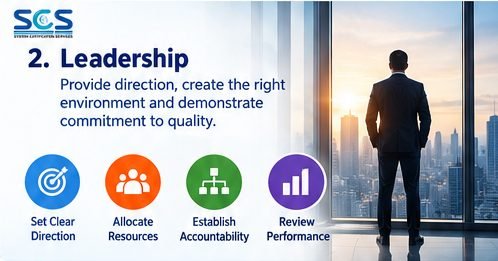
Leadership gives quality management direction. Senior management is responsible for establishing priorities, assigning responsibilities and making sure that quality is considered when business decisions are taken.
A quality policy displayed on an office wall has limited value if management decisions consistently ignore quality problems.
Practical examples
Manufacturing: Production targets are putting pressure on employees to release products before inspection is complete. Management reviews the issue and establishes that product conformity cannot be bypassed to meet a delivery target.
Construction: Project managers, procurement personnel and site supervisors are working with different interpretations of approved specifications. Leadership establishes clear authority for technical approvals and changes.
Service business: Customer complaints are repeatedly passed between departments without ownership. Management assigns responsibility for complaint resolution and reviews overdue cases.
UAE-based supplier: A company responding to a customer or tender requirement establishes management responsibility for maintaining its QMS, monitoring performance and ensuring that relevant employees understand their roles.
How to apply leadership
Management should participate in quality objectives, performance reviews, resource decisions and improvement activities.
The practical test is whether quality considerations influence decisions when they compete with cost, speed or short-term convenience.
3. Engagement of People
Employees are directly involved in the activities that determine product and service quality. Their competence, awareness and participation therefore have a significant effect on QMS performance.
Engagement does not mean asking employees to attend more meetings. It means giving people the knowledge, responsibility and opportunity to contribute to better work.
Practical examples
Warehouse: Store employees notice that two similar products are regularly mixed during picking. They suggest clearer identification and a revised storage arrangement.
Engineering: A technician identifies that a recurring equipment issue is linked to an unclear maintenance instruction. The organization reviews the instruction and provides practical guidance.
Customer support: Employees identify that a particular enquiry is being transferred between departments unnecessarily. The company reviews the responsibility structure and simplifies the handling process.
Manufacturing: Operators are encouraged to report process abnormalities before defective products reach final inspection.
How to apply engagement
Organizations can review competence requirements, provide suitable training, communicate responsibilities and encourage employees to report problems.
Employee suggestions should also receive feedback. If people repeatedly raise concerns without seeing any response, participation is unlikely to remain meaningful.

4. Process Approach
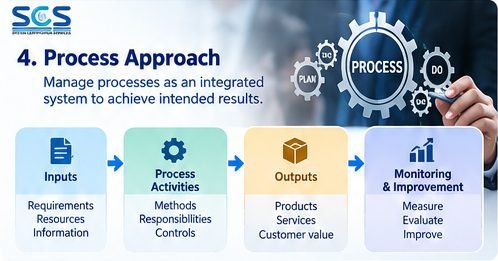
The process approach recognizes that business results depend on connected activities, not isolated departments.
A quotation may become a contract, which leads to procurement, production or service delivery, inspection and final handover. A weakness at one stage can affect the entire customer experience.
Practical examples
Trading company: Sales accepts an order without confirming stock availability. Procurement then faces an urgent purchasing requirement, and delivery is delayed. Reviewing the complete order process helps identify where confirmation should take place.
Construction company: Procurement, technical review and site execution are managed separately. Materials arrive before the required technical approval is complete. A connected approval process helps prevent avoidable delays.
Manufacturing: Production output is satisfactory, but final inspection identifies repeated defects. Reviewing production inputs, machine settings, operator competence and inspection feedback may reveal the actual process weakness.
IT service provider: Customer requests are received through several channels, but there is no consistent method for assigning priority or tracking closure. A defined service-request process improves visibility.
How to apply the process approach
Identify the important processes, their inputs and outputs, responsible personnel, controls and performance measures.
A process map can help, but it should reflect how work actually happens. A diagram that looks complete while employees follow a different process will not improve performance.
5. Improvement
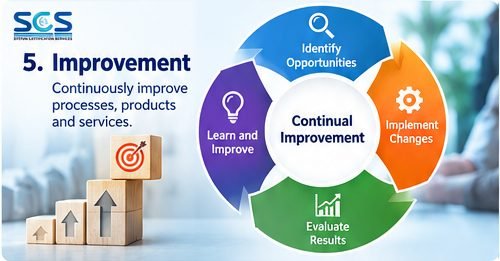
Improvement is about making products, services and processes more effective over time.
It includes major changes, but many useful improvements are small. Reducing a recurring error, simplifying an approval or improving the way information is communicated can have a measurable effect.
Practical examples
Manufacturing: Rework has increased over several months. The organization investigates the cause, adjusts the relevant process control and compares defect data after the change.
Logistics: Delivery delays are concentrated around a particular route or operating period. Management reviews scheduling and resource allocation rather than treating each late delivery as an isolated event.
Professional services: Reports are frequently returned for correction because information is missing. The company revises its review checklist and monitors the number of reports requiring rework.
Construction: Repeated documentation errors are delaying project approvals. The organization introduces a clearer document review and submission process.
How to apply improvement
Use information from customer feedback, internal audits, process monitoring, nonconformities and employee suggestions to identify opportunities.
After making a change, check whether it achieved the intended result. An action should not be considered effective simply because it has been completed.
6. Evidence-Based Decision-Making
Evidence-based decision-making means using reliable information when evaluating performance and choosing actions.
Experience and professional judgment remain valuable, but decisions become more dependable when they are supported by relevant data.
Practical examples
Supplier management: A purchasing manager is considering whether to continue using a supplier. Instead of relying only on the length of the business relationship, the company reviews delivery performance, product conformity and responsiveness.
Customer service: Management receives complaints about slow response times. It examines response records by category and department to determine where delays occur.
Manufacturing: A production manager suspects that a machine is causing defects. Inspection and maintenance records are reviewed before deciding whether equipment adjustment, maintenance or another action is needed.
Project management: A contractor reviews progress, inspection results, outstanding approvals and nonconformities before revising the project plan.
How to apply evidence-based decisions
Choose indicators that help answer real management questions.
Examples include:
-
Customer complaints
-
On-time delivery
-
Product defects
-
Rework levels
-
Supplier performance
-
Service response time
-
Corrective-action effectiveness
-
Customer satisfaction
Collecting large amounts of information is not the objective. The information should be accurate, relevant and useful for deciding what to do next.

7. Relationship Management
Organizations depend on relationships with suppliers, contractors, service providers, customers and other interested parties.
Relationship management involves understanding these connections and managing them in a way that supports consistent performance.
It does not mean accepting every supplier condition or avoiding difficult discussions. It means establishing clear expectations, reviewing performance and addressing problems constructively.
Practical examples
Manufacturing: A critical supplier repeatedly delivers materials outside agreed specifications. The manufacturer discusses the performance issues, clarifies acceptance criteria and monitors corrective action.
Construction: A subcontractor's work affects the main contractor's project schedule. Responsibilities, inspection requirements and communication arrangements are agreed before work begins.
Logistics: A transport provider and its customer establish clear arrangements for shipment updates, delivery evidence and escalation of delays.
Professional services: An organization reviews the performance of an outsourced IT provider because service availability affects its own customer commitments.
How to apply relationship management
Organizations can establish suitable supplier evaluation criteria, communicate requirements, monitor performance and review important external relationships.
The level of control should reflect the effect of the externally provided product or service on the organization's ability to meet requirements.

How the Seven Principles Work Together
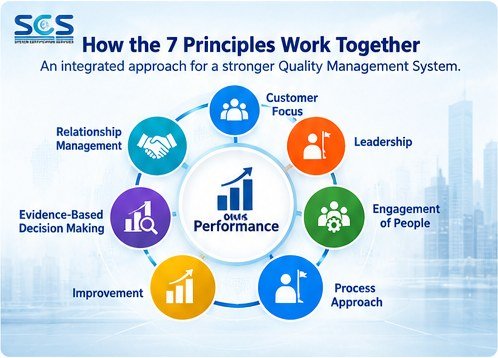
The principles are connected. Applying one without considering the others may address a symptom while leaving the underlying problem unresolved.
Consider a UAE-based manufacturing company receiving complaints about late deliveries.
| Principle | Practical application |
|---|---|
| Customer focus | Understand delivery commitments and customer concerns |
| Leadership | Assign ownership and provide resources |
| Engagement of people | Involve planning, warehouse and dispatch employees |
| Process approach | Review order processing, production planning and dispatch as connected activities |
| Improvement | Introduce changes to address identified causes |
| Evidence-based decision-making | Monitor delivery performance before and after the changes |
| Relationship management | Review supplier and logistics-provider performance |
The company does not need seven separate improvement projects. It can address one business problem using the principles together.
Quality Management Principles Across UAE Industries
The principles can be applied across different sectors operating in the UAE.
| Industry | Example of practical application |
|---|---|
| Construction and engineering | Control project requirements, approvals, subcontractors and handover |
| Manufacturing | Reduce defects, improve production controls and monitor suppliers |
| Trading and distribution | Improve order accuracy, stock availability and delivery performance |
| Logistics | Monitor delivery commitments, customer communication and external providers |
| IT and technology | Manage service requests, customer requirements and service performance |
| Healthcare services | Improve process consistency, service feedback and operational controls |
| Education and training | Review learner feedback, service delivery and improvement actions |
| Professional services | Clarify deliverables, responsibilities and customer communication |
For organizations in Dubai, Abu Dhabi, Sharjah and other Emirates, the specific application will depend on the business activity, customer requirements and QMS scope.
The principles themselves are not geographically restricted. Their practical value comes from how well they reflect the organization's operating conditions.
Difference Between ISO 9000 and ISO 9001
ISO 9000 and ISO 9001 are related, but they serve different purposes.
ISO 9000 provides fundamentals and vocabulary for quality management systems. It helps organizations understand the concepts and terminology used within the ISO 9000 family.
ISO 9001 specifies requirements for a Quality Management System. It is the standard used for ISO 9001 certification.
The seven quality management principles provide a foundation for understanding quality management, while ISO 9001 establishes the requirements against which a QMS can be assessed.
Organizations can explore the relevant standards through the SCS Certification standards directory.
How the Principles Support ISO 9001 Certification
The seven principles help explain why a Quality Management System should be more than a collection of documents.
During QMS development and assessment, organizations need to demonstrate that their processes are established, implemented and maintained in accordance with the applicable requirements.
The principles provide useful context for:
-
Understanding customer needs
-
Establishing management responsibilities
-
Determining employee competence
-
Managing connected processes
-
Reviewing performance
-
Addressing nonconformities
-
Improving the QMS
-
Managing relevant external providers
For companies seeking ISO 9001 certification in the UAE, these concepts can help management and employees understand the purpose behind their quality-management activities.
Certification requirements, scope and audit arrangements should be confirmed with the relevant certification body.
For information about SCS Certification and its services, visit SCS Certification.
Common Mistakes When Applying Quality Management Principles
Organizations can misunderstand the principles when they focus on paperwork rather than operational results.
Common examples include:
Treating customer focus as a satisfaction survey: Feedback is collected, but complaints and recurring concerns are not investigated.
Leaving quality entirely to the quality department: Other departments do not take responsibility for the performance of their own processes.
Providing training without checking competence: Attendance is recorded, but the organization does not evaluate whether employees can perform their assigned work.
Creating process maps that do not reflect actual activities: The documented process looks complete, but employees follow a different sequence.
Closing corrective actions without checking effectiveness: The immediate issue is resolved, but the same problem returns.
Collecting KPIs without using them: Reports are prepared regularly, but management decisions do not change.
Managing suppliers only when something goes wrong: Performance is not reviewed until a delivery failure or customer complaint occurs.
A useful quality management system should help prevent these situations rather than simply record them.
Practical Checklist for Applying the Seven Principles
Organizations can use the following questions during an internal review.
| Principle | Review question |
|---|---|
| Customer focus | Do we understand and review relevant customer requirements? |
| Leadership | Does management take responsibility for QMS performance? |
| Engagement of people | Do employees understand their roles and have opportunities to raise concerns? |
| Process approach | Are important processes and their interactions understood? |
| Improvement | Do we investigate recurring problems and check whether actions work? |
| Evidence-based decision-making | Are decisions supported by relevant performance information? |
| Relationship management | Are important suppliers and external providers evaluated and monitored appropriately? |
The checklist is a practical discussion aid, not a substitute for assessing the applicable ISO 9001 requirements.
Conclusion
The seven quality management principles help organizations approach quality as part of everyday business management.
Customer focus helps clarify what needs to be delivered. Leadership establishes direction. Engaged employees contribute to reliable work. The process approach connects activities. Improvement addresses weaknesses. Evidence supports decisions, while relationship management helps maintain dependable external arrangements.
For businesses in the UAE and elsewhere, these principles can provide a useful foundation for a QMS that reflects actual operations rather than relying on documentation alone.
Organizations considering ISO 9001 certification can use the principles to understand the purpose of quality management before moving into the detailed requirements and certification process.
For further information, contact SCS Certification to discuss your organization's certification requirements.
References
-
ISO 9000 — Quality management systems: Fundamentals and vocabulary
https://www.iso.org/standard/9000 -
ISO 9000 family of quality management standards
https://www.iso.org/standards/popular/iso-9000-family -
ISO — Quality management principles
https://www.iso.org/publication/PUB100080.html -
SCS Certification
https://www.scscertification.com/
Need ISO 9001 Certification for Your Business?
Speak with our certification specialists to understand certification requirements, audit process, implementation timelines and accredited certification services.
Frequently Asked Questions
For detailed revision information, refer to the ISO 9001:2026 changes and requirements guide. https://www.scscertification.com/blog/iso-9001-2026-changes-clause-by-clause-guide-requirements-implementation/