CE Marking Certification for Medical Devices in UAE | EU MDR 2017/745 | SCS
CE Marking Certification for Medical Devices in UAE
Need CE marking certification for medical devices under EU MDR 2017/745? Contact SCS for a free certification enquiry.
★★★★★
Medical devices manufactured, assembled or supplied by UAE companies may need to meet European conformity requirements when they are intended to be placed on the European market. For manufacturers, OEMs, exporters and healthcare-product companies, CE marking is therefore more than a mark placed on packaging. It is the result of a conformity assessment process based on the applicable European legislation, the characteristics of the device and its intended purpose.
The European Union Medical Device Regulation, Regulation (EU) 2017/745, commonly called the EU MDR, provides the principal regulatory framework for medical devices placed on the EU market. It addresses areas including device classification, general safety and performance requirements, technical documentation, clinical evaluation, risk management, quality management, post-market surveillance, UDI and conformity assessment.
For a UAE manufacturer, the starting point is not simply to ask, "How do I get a CE certificate?" The more useful question is:
What is the device, what is its intended purpose, which MDR requirements apply, what classification does it have, and what conformity assessment route is required?
That approach is particularly important because medical devices can range from relatively simple non-invasive products to software, active equipment, surgical instruments, implants and higher-risk Class III devices.
SCS supports organizations in the UAE with medical-device CE conformity assessment services covering product classification, technical documentation, risk management, clinical evidence and applicable conformity requirements.
What Is CE Marking for Medical Devices?
CE marking is the formal indication that a product has completed the applicable conformity assessment requirements under the European legislation covering that product.
For medical devices, CE marking is connected with compliance with the applicable requirements of Regulation (EU) 2017/745. Depending on the device, its classification and the applicable conformity assessment procedure, the manufacturer may have different obligations and may need involvement from a notified body.
CE marking should therefore not be treated as a universal certificate that is identical for every medical device.
The assessment route depends on the product.
A diagnostic device, surgical instrument, medical software application, implant and reusable surgical instrument can have substantially different regulatory requirements.
The MDR establishes separate provisions for:
- General safety and performance requirements
- Technical documentation
- Clinical evaluation
- Post-market surveillance
- EU Declaration of Conformity
- CE marking
- UDI
- Notified bodies
- Device classification
- Conformity assessment
- Custom-made devices
- Clinical investigations
- Post-market clinical follow-up
These requirements are distributed across the Regulation and its annexes.
EU MDR 2017/745 for Medical Devices
What Is EU MDR 2017/745?
Regulation (EU) 2017/745 is the European Union's Medical Device Regulation.
It replaced the previous EU medical-device framework based principally on the Medical Devices Directive and the Active Implantable Medical Devices Directive.
The MDR applies to medical devices and certain related products placed on the European market or put into service within its scope.
For manufacturers, MDR compliance involves the complete product lifecycle rather than only the final certification stage.
The manufacturer may need to establish evidence covering:
- Intended purpose
- Device classification
- Design and manufacturing
- Risk management
- Safety and performance
- Clinical evaluation
- Verification and validation
- Labelling
- Instructions for use
- Technical documentation
- Quality management
- Post-market surveillance
- Vigilance
- UDI
- Conformity assessment
Article 10 of the MDR establishes manufacturer obligations relating to conformity, risk management, clinical evaluation and technical documentation.
MDR and CE Marking
The MDR does not mean that every medical device follows exactly the same certification process.
The applicable route depends on factors such as:
- Intended purpose
- Risk
- Invasiveness
- Duration of use
- Whether the device is active
- Whether it is implantable
- Whether it is sterile
- Whether it has a measuring function
- Whether it is software
- Whether it incorporates particular substances or materials
- The applicable classification rule
This is why product classification should normally be addressed before a manufacturer commits to a certification route.
Medical Devices Covered by CE Marking Certification
One of the most important parts of medical-device CE assessment is identifying exactly what the product is.
A medical-device manufacturer may produce a single product, a product family or a large portfolio containing devices with different classifications.
SCS can support assessment of a broad range of medical-device categories, subject to the applicable European regulatory framework and conformity assessment scope.
Diagnostic Medical Devices
Diagnostic products may include:
- Diagnostic equipment
- Clinical diagnostic devices
- Diagnostic monitoring equipment
- Physiological measurement equipment
- Diagnostic imaging-related equipment
- Patient diagnostic systems
The regulatory route depends on the device's intended purpose and technical characteristics rather than simply its commercial description.
Surgical Medical Devices
Surgical products can include:
- Surgical instruments
- Surgical equipment
- Surgical accessories
- Invasive surgical devices
- Reusable surgical instruments
- Surgical devices used in operating environments
Reusable surgical instruments have specific MDR considerations and should not automatically be treated in the same way as ordinary Class I products.
Dental Medical Devices
Dental products can include:
- Dental instruments
- Dental treatment equipment
- Dental surgical devices
- Dental implants
- Dental accessories
- Orthodontic-related medical devices
- Other dental healthcare products
The appropriate MDR classification depends on intended purpose and the applicable classification rules.
Orthopaedic Medical Devices
Orthopaedic products may include:
- Orthopaedic implants
- Bone fixation devices
- Orthopaedic surgical products
- Joint-related devices
- Orthopaedic supports
- Orthopaedic rehabilitation devices
Implantable and long-term invasive products can involve significantly different conformity requirements from non-invasive orthopaedic products.
Implantable Medical Devices
Implantable products can include:
- Orthopaedic implants
- Dental implants
- Cardiovascular implants
- Surgical implants
- Implantable therapeutic devices
- Other long-term implantable devices
Implantable devices require careful classification because MDR Annex VIII contains specific rules affecting implantable and long-term invasive devices.
Patient Monitoring Devices
This category may include:
- Patient monitors
- Vital-sign monitoring equipment
- Physiological monitoring devices
- Clinical monitoring systems
- Wearable monitoring devices
- Monitoring software
The intended purpose of the monitoring function is particularly important when determining the applicable classification.
Active Medical Devices
Active medical devices depend on a source of energy other than energy generated directly by the human body or gravity.
Examples can include:
- Powered medical equipment
- Active therapeutic equipment
- Active diagnostic equipment
- Monitoring equipment
- Electrically operated medical systems
The classification route depends on the particular device and applicable MDR rule.
Therapeutic Medical Devices
Therapeutic devices can include:
- Treatment equipment
- Active therapeutic devices
- Rehabilitation equipment
- Energy-based medical equipment
- Therapy systems
- Treatment-support devices
The intended therapeutic purpose and potential risk to the patient are important considerations in classification.
Respiratory Medical Devices
Respiratory products may include:
- Respiratory therapy equipment
- Ventilation-related medical devices
- Respiratory support devices
- Oxygen-related medical equipment
- Respiratory monitoring equipment
The regulatory assessment depends on the actual function, intended purpose and technical characteristics.
Infusion and Administration Devices
Potential products include:
- Infusion devices
- Infusion pumps
- Administration systems
- Fluid-delivery devices
- Devices used to administer medicinal products
Products that administer or transport medicinal products or substances may involve additional MDR considerations.
Hospital and Healthcare Equipment
Medical-device manufacturers supplying hospitals may produce:
- Patient-care equipment
- Hospital medical equipment
- Treatment equipment
- Monitoring equipment
- Medical support equipment
- Healthcare technology
Not every item used inside a hospital is automatically a medical device. The manufacturer's intended purpose and the MDR definition must be considered.
Medical Consumables
Medical consumables may include:
- Sterile medical products
- Disposable medical devices
- Single-use devices
- Wound-care products
- Patient-care products
- Other healthcare consumables
Sterility, intended use, invasiveness and duration of contact can affect the applicable regulatory route.
Rehabilitation Devices
Rehabilitation products may include:
- Mobility-support devices
- Physical rehabilitation equipment
- Therapeutic rehabilitation devices
- Patient-support equipment
- Assistive medical devices
The classification depends on the device's intended medical purpose and applicable MDR classification rule.
Medical Device Software and Digital Health Products
Medical software deserves particular attention because the software's intended purpose can directly influence whether it falls within the MDR and how it is classified.
Products may include:
- Standalone medical software
- Diagnostic software
- Monitoring software
- Clinical decision-support software
- Mobile medical applications
- Software controlling medical equipment
- Software incorporated into medical devices
- Patient management software where it meets the MDR definition
A software product should not be classified simply because it is marketed as a healthcare application.
The manufacturer should establish its intended purpose and assess whether the software meets the applicable medical-device definition and classification requirements.
MDR classification rules specifically address software, including software that provides information used to make diagnostic or therapeutic decisions.
Future SCS article opportunity:
Medical Device Software CE Certification in UAE | MDR Rule 11
Medical Device Classification Under EU MDR
Classification is one of the most important stages in the CE certification process.
The MDR classification framework includes:
- Class I
- Class IIa
- Class IIb
- Class III
The classification is determined according to the applicable rules in Annex VIII.
The classification can depend on:
- Intended purpose
- Invasiveness
- Duration of use
- Implantability
- Whether the device is active
- Whether the device is used for diagnosis or monitoring
- Whether it is therapeutic
- Whether software is involved
- Whether the device administers or contains substances
- The anatomical location
- Potential risks
The MDR's Annex VIII contains the classification rules used to determine the applicable class.
Class I Medical Devices
Class I generally represents lower-risk devices, but Class I does not mean that the manufacturer has no regulatory responsibilities.
Class I devices still require applicable technical documentation, conformity with the MDR, appropriate labelling, risk management and other applicable obligations.
Certain Class I devices have additional requirements.
These include:
- Class I sterile devices
- Class I measuring devices
- Class I reusable surgical instruments
The applicable conformity assessment requirements must therefore be determined from the actual device.
Class IIa Medical Devices
Class IIa devices generally have a higher level of regulatory involvement than ordinary Class I devices.
Depending on the device and applicable conformity assessment route, notified-body involvement may be required.
Class IIb Medical Devices
Class IIb devices generally involve a higher level of risk and more extensive conformity assessment.
Technical documentation, clinical evidence, risk management and quality-system requirements can become particularly important.
Class III Medical Devices
Class III devices represent the highest MDR risk class.
Examples can include certain implantable and high-risk devices.
These products generally require extensive conformity assessment and notified-body involvement, together with detailed technical and clinical evidence.
Why Classification Matters
The classification affects the route that follows.
An incorrect classification can therefore lead to:
- Incorrect conformity assessment
- Incomplete documentation
- Delays
- Additional testing
- Additional clinical evidence requirements
- Notified-body assessment problems
- Labelling problems
- Incorrect certification planning
For this reason, classification should be established early.
MDR Classification Rules for Medical Devices
MDR Annex VIII provides detailed classification rules.
Non-Invasive Devices
The applicable classification depends on the function and intended use of the device.
Invasive Devices
The assessment considers factors such as the type of invasiveness and duration of use.
Surgically Invasive Devices
Surgically invasive products require classification according to the applicable MDR rules.
Implantable Devices
Implantable and long-term invasive products have specific classification provisions.
Active Devices
Active diagnostic, monitoring and therapeutic devices have dedicated classification rules.
Medical Device Software
Software classification depends on its intended purpose and the significance of the information it provides or the function it performs.
Substance-Based Devices
Devices based on substances or combinations of substances can fall under specific MDR classification rules.
Special Medical Devices
Special classification considerations can apply to products involving:
- Contraception
- Disinfection
- Sterilization
- Inhalation
- Nanomaterials
- Human or animal tissues
- Medicinal substances
- Integrated diagnostic and therapeutic functions
The applicable rule must be assessed against the actual product rather than assumed from the product name.
MDR Conformity Assessment for Medical Devices
Once classification has been established, the applicable conformity assessment route can be determined.
The MDR includes several conformity assessment routes and procedures.
Its annexes cover:
- Quality management system assessment
- Technical documentation assessment
- EU type examination
- Product conformity verification
- Certificates issued by notified bodies
- Custom-made device procedures
These are set out across Annexes IX to XIII.
Class I Conformity Assessment
For an ordinary Class I device, the manufacturer may generally follow the applicable self-declaration route where permitted.
However, special Class I categories such as sterile, measuring and reusable surgical instruments require additional assessment for the aspects specified by the MDR.
Class IIa Conformity Assessment
Class IIa devices generally require a conformity assessment route involving a notified body.
The exact procedure depends on the device and selected MDR route.
Class IIb Conformity Assessment
Class IIb devices require more extensive assessment than lower-risk devices.
Technical documentation, QMS and clinical evidence may be subject to detailed assessment.
Class III Conformity Assessment
Class III devices are subject to the highest level of regulatory scrutiny under the MDR.
The appropriate notified-body conformity assessment route should be established at the beginning of the project.
Role of the Notified Body
A notified body is an organization designated under the applicable EU framework to perform specified conformity assessment activities.
Not every medical device follows the same notified-body route.
This is one reason why a manufacturer should determine classification and conformity requirements before selecting a certification arrangement.
Medical Device Technical Documentation
Technical documentation is central to demonstrating MDR conformity.
The MDR's Annex II specifies important technical documentation elements, while Annex III addresses post-market surveillance documentation.
A technical documentation package can include:
Device Description
- Product name
- Model
- Variants
- Accessories
- Configurations
- Intended purpose
- Intended users
- Patient population
Design and Manufacturing Information
- Design specifications
- Drawings
- Components
- Materials
- Manufacturing processes
- Critical production controls
Risk Management Documentation
- Hazard identification
- Risk analysis
- Risk controls
- Residual risks
- Benefit-risk considerations
General Safety and Performance Requirements
The manufacturer needs to demonstrate how applicable MDR requirements are addressed.
Verification and Validation
Depending on the product, this can include:
- Performance testing
- Electrical safety testing
- EMC testing
- Mechanical testing
- Biocompatibility
- Sterility validation
- Packaging validation
- Software validation
- Usability-related evidence
Labelling and Instructions for Use
Documentation should support the information provided with the device.
Clinical Documentation
Clinical evaluation and supporting clinical evidence form an important part of MDR compliance.
MDR General Safety and Performance Requirements
The MDR uses General Safety and Performance Requirements, commonly referred to as GSPR.
Annex I covers these requirements. They address areas such as:
- Safety
- Performance
- Risk reduction
- Materials
- Chemical properties
- Biological compatibility
- Infection control
- Contamination
- Mechanical properties
- Electrical safety where applicable
- Radiation
- Software
- Packaging
- Labelling
- Information supplied by the manufacturer
The device must be designed and manufactured to achieve its intended performance while meeting the applicable safety requirements.
A practical MDR assessment therefore needs more than a general statement that the product is safe.
The manufacturer should be able to show how each applicable requirement is addressed through documentation, testing, risk management or other appropriate evidence.
Future SCS article opportunity:
MDR GSPR Checklist for Medical Devices
Medical Device Risk Management
Risk management is a core part of the MDR framework.
Manufacturers are required to establish, document, implement and maintain a risk-management system appropriate to their devices.
A medical-device risk-management process can address:
- Intended use
- Foreseeable misuse
- Hazards
- Hazardous situations
- Risk estimation
- Risk evaluation
- Risk controls
- Residual risks
- Benefit-risk determination
- Production and post-production information
ISO 14971 is widely used as the principal medical-device risk-management standard.
Risk management should not be treated as a document prepared only at the end of certification.
It should connect with design, testing, clinical evaluation, manufacturing and post-market information.
Clinical Evaluation for Medical Devices
Clinical evaluation is another major MDR requirement.
The manufacturer needs to establish appropriate clinical evidence supporting the safety and performance of the device for its intended purpose.
Clinical evaluation can involve:
- Clinical evaluation planning
- Scientific literature
- Clinical data
- Clinical investigations
- Equivalence considerations
- Benefit-risk evaluation
- Clinical evaluation reports
- Post-market clinical follow-up
The MDR's Article 61 and Annex XIV provide the framework for clinical evaluation and post-market clinical follow-up.
The level of clinical evidence required depends on the device and its characteristics.
Higher-risk devices may require substantially more extensive clinical evidence.
Future SCS article opportunity:
MDR Clinical Evaluation and Clinical Evaluation Report for Medical Devices
ISO 13485 and EU MDR
ISO 13485 is a separate medical-device quality-management standard, while EU MDR 2017/745 is European legislation.
They should not be treated as interchangeable.
However, an appropriate quality-management system can be an important part of MDR conformity assessment, particularly for devices requiring notified-body involvement.
An MDR quality-management system can address:
- Design controls
- Document control
- Supplier controls
- Manufacturing controls
- Risk management
- CAPA
- Complaints
- Change control
- Post-market surveillance
- Regulatory responsibilities
SCS also provides ISO 13485 Certification in UAE, making this a relevant supporting service for organizations building a medical-device compliance framework.
Future SCS article opportunity:
ISO 13485 Certification for Medical Devices in UAE
Medical Device UDI and Registration
The MDR introduced an extensive Unique Device Identification framework.
UDI requirements are intended to support identification and traceability of medical devices.
Relevant concepts include:
- Basic UDI-DI
- UDI-DI
- UDI-PI
- Device identification
- Traceability
- Registration
- Economic operator information
- EUDAMED
UDI requirements should be planned alongside technical documentation and product identification rather than added at the final stage.
The MDR's Annex VI addresses device and economic-operator registration information as well as the UDI system.
Future SCS article opportunity:
MDR UDI and EUDAMED Registration Requirements
EU Declaration of Conformity for Medical Devices
After completing the applicable conformity assessment process, the manufacturer prepares the EU Declaration of Conformity.
The declaration is the manufacturer's formal statement that the applicable requirements have been met.
The MDR includes a dedicated Annex IV covering the EU Declaration of Conformity.
The declaration should correspond with the actual device, manufacturer, applicable legislation and conformity assessment route.
Manufacturers should also maintain the supporting technical documentation.
CE Marking Requirements for Medical Devices
CE marking is applied after the applicable conformity assessment requirements have been completed.
Depending on the device and conformity assessment route:
- The manufacturer may be able to complete the applicable declaration route directly.
- A notified body may be required.
- A notified-body identification number may appear alongside the CE mark where required.
- The marking must follow the applicable MDR requirements.
The CE mark should therefore be considered the final visible result of a much broader regulatory process.
It is not a substitute for technical documentation, clinical evidence, risk management or applicable conformity assessment.
Post-Market Surveillance Under EU MDR
MDR compliance continues after the product reaches the market.
Manufacturers have post-market obligations that can include:
- Post-market surveillance
- Complaint monitoring
- Trend monitoring
- Vigilance
- Serious incident reporting
- Field safety corrective actions
- Post-market clinical follow-up
- Periodic safety reporting where applicable
- Corrective and preventive actions
The MDR specifically includes post-market surveillance documentation and post-market clinical follow-up within its regulatory framework.
A manufacturer should therefore plan its post-market system before CE marking rather than treating it as a separate activity after certification.
Medical Device Labelling and Instructions for Use
Medical-device labelling is an important part of MDR conformity.
Depending on the device, information can include:
- Manufacturer name
- Manufacturer address
- Device identification
- UDI information
- CE marking
- Applicable symbols
- Warnings
- Precautions
- Intended purpose
- Storage information
- Sterility information
- Expiry information
- Instructions for use
The labelling must be consistent with the technical documentation and intended purpose.
Changes made to product claims or labelling can therefore have implications for the regulatory documentation.
Custom-Made Medical Devices
Custom-made medical devices follow a specific MDR pathway.
They should not simply be treated as ordinary mass-produced medical devices.
The MDR contains dedicated provisions for custom-made devices under Annex XIII and related provisions.
Manufacturers should determine:
- Whether the product genuinely qualifies as custom-made
- The applicable documentation
- The manufacturer's responsibilities
- The applicable conformity route
- Whether additional requirements apply because of device classification
Medical Device Systems and Procedure Packs
Some medical products are supplied as systems or procedure packs containing several components.
The manufacturer should determine:
- Which components are medical devices
- Which components are accessories
- Whether the products are combined for a specific purpose
- Who is responsible for the system or procedure pack
- What documentation is required
- What CE-marking provisions apply
This area can become particularly relevant for hospitals, surgical suppliers and manufacturers supplying complete healthcare packages.
Medical Devices and IVDs: MDR vs IVDR
Medical devices and in vitro diagnostic medical devices should not be automatically grouped under the same regulation.
Medical devices are principally addressed under EU MDR 2017/745.
In vitro diagnostic medical devices are addressed under the separate EU IVDR 2017/746 framework.
Examples of IVD-related products can include certain:
- Diagnostic reagents
- Test kits
- Specimen-related diagnostic products
- Laboratory diagnostic systems
- IVD software
A manufacturer should therefore determine whether the product falls under MDR or IVDR before planning CE certification.
Future SCS article opportunity:
CE Marking Certification for IVD Medical Devices in UAE | EU IVDR 2017/746
Medical Device CE Certification Process in UAE
For a UAE manufacturer or exporter, the practical certification process can be approached in stages.
Step 1: Identify the Product
Provide the product name, model, technical specifications and intended use.
Step 2: Establish the Intended Purpose
The intended purpose is central to determining whether and how the MDR applies.
Step 3: Determine the Classification
Apply the relevant MDR classification rules.
Step 4: Identify Applicable Requirements
Determine the applicable MDR provisions, standards and conformity assessment requirements.
Step 5: Review Technical Documentation
Assess existing product documentation, drawings, specifications, test reports and supporting evidence.
Step 6: Establish Risk Management
Develop and maintain the appropriate risk-management documentation.
Step 7: Complete Clinical Evaluation
Determine the clinical evidence required for the specific device.
Step 8: Establish the Applicable Quality System
Where required, ensure that the manufacturer's quality-management arrangements support the applicable MDR conformity route.
Step 9: Complete Conformity Assessment
Conduct the applicable assessment, including notified-body assessment where required.
Step 10: Prepare the EU Declaration of Conformity
Prepare the manufacturer's declaration after the applicable requirements have been fulfilled.
Step 11: Apply CE Marking
Apply the CE marking according to the applicable MDR provisions.
Step 12: Complete UDI and Registration Requirements
Complete applicable identification and registration activities.
Step 13: Maintain Post-Market Compliance
Continue surveillance, vigilance, clinical follow-up and other applicable obligations.
The exact process can vary considerably between a Class I non-sterile device and a Class III implantable product.
Documents Required for Medical Device CE Certification
The documents required depend on the device and its classification.
Typical documentation can include:
- Product description
- Intended purpose
- Product specifications
- Device variants
- Accessories
- Design drawings
- Manufacturing information
- Material information
- Risk-management file
- GSPR assessment
- Test reports
- Verification and validation records
- Biocompatibility evidence where applicable
- Electrical safety reports where applicable
- EMC reports where applicable
- Software documentation where applicable
- Clinical evaluation
- Clinical evidence
- Labelling
- Instructions for use
- Packaging information
- Sterilization documentation where applicable
- Quality-management documentation
- PMS documentation
- PMCF documentation where applicable
- EU Declaration of Conformity
The MDR requires technical documentation to be maintained in a clear and organized form sufficient to demonstrate conformity.
Medical Device CE Certification Cost in UAE
There is no single CE certification price that applies to every medical device.
The cost can vary according to:
- Medical device classification
- Number of products
- Number of models
- Product complexity
- Existing technical documentation
- Testing requirements
- Clinical evidence
- Software
- Sterilization
- Quality-management arrangements
- Notified-body involvement
- Existing certifications
- Number of manufacturing locations
- Required conformity assessment route
A manufacturer requesting a quotation should ideally provide enough product information for the applicable certification scope to be assessed.
For a straightforward quotation enquiry, useful information can include:
- Product name
- Product description
- Intended purpose
- Model numbers
- Classification, if already established
- Manufacturing location
- Existing certifications
- Technical documentation available
- Target European market
- Whether the product is sterile
- Whether the product is software
- Whether the product is implantable
- Whether clinical data is already available
For a product-specific quotation, contact SCS with the device details and available technical documentation.
How Long Does Medical Device CE Certification Take?
There is no universal timeline for every medical device.
The duration can depend on:
- Classification
- Technical complexity
- Documentation readiness
- Clinical evidence
- Testing requirements
- QMS readiness
- Notified-body involvement
- Number of models
- Product changes
- Manufacturing arrangements
A manufacturer with a mature technical file and existing evidence may have a different project timeline from a company developing documentation for a new Class IIb or Class III device.
Starting the regulatory review early can reduce avoidable delays.
Medical Device CE Certification for UAE Manufacturers
UAE manufacturers may seek CE conformity when supplying medical devices to European customers or preparing products for the European market.
The same consideration applies to:
- OEM manufacturers
- Contract manufacturers
- Private-label manufacturers
- Healthcare equipment manufacturers
- Medical technology companies
- Medical device exporters
- Product developers
- Medical equipment suppliers
The destination market should always be considered separately from UAE-specific regulatory requirements.
CE marking under EU legislation does not automatically replace applicable UAE regulatory approvals or registration requirements.
Medical Device CE Certification in Dubai
Dubai is home to medical-device companies, healthcare suppliers, technology companies, manufacturers and international trading organizations.
Businesses based in Dubai may seek CE conformity support for products intended for European markets.
SCS supports medical-device certification enquiries from organizations operating in:
- Dubai
- Dubai Healthcare City
- Jebel Ali
- Dubai Science Park
- Dubai Industrial City
- Dubai Investment Park
- Other Dubai business and industrial locations
Medical Device CE Certification in Abu Dhabi
Abu Dhabi has a substantial healthcare, industrial and manufacturing ecosystem.
Medical-device manufacturers, suppliers and exporters based in Abu Dhabi can seek applicable CE conformity assessment support for products intended for European markets.
SCS supports enquiries from organizations operating in:
- Abu Dhabi
- Al Ain
- Mussafah
- ICAD
- KIZAD
- Other Abu Dhabi industrial and commercial areas
Medical Device CE Certification Across the UAE
SCS supports medical-device certification enquiries throughout the UAE, including:
- Dubai
- Abu Dhabi
- Sharjah
- Ajman
- Ras Al Khaimah
- Fujairah
- Umm Al Quwain
- Al Ain
The applicable conformity route depends on the product rather than simply the emirate in which the manufacturer is located.
Medical Device Products That Can Require CE Certification Support
The medical-device product range is broad.
SCS enquiries may involve:
- Diagnostic devices
- Surgical instruments
- Dental devices
- Orthopaedic devices
- Implantable devices
- Patient monitoring devices
- Active medical devices
- Therapeutic equipment
- Respiratory devices
- Infusion devices
- Rehabilitation devices
- Hospital equipment
- Medical consumables
- Sterile medical devices
- Measuring medical devices
- Reusable surgical instruments
- Medical device software
- Custom-made medical devices
- Other products falling within the MDR framework
The actual regulatory status of a product should always be confirmed from its intended purpose and technical characteristics.
Medical Device CE Certification and Future Product-Specific Services
The broad MDR framework creates separate opportunities for manufacturers with different product requirements.
Future product-specific certification resources can address:
Diagnostic Medical Device CE Certification
Detailed requirements for diagnostic equipment and related medical devices.
Surgical Medical Device CE Certification
Requirements for surgical instruments and surgical medical devices.
Dental Medical Device CE Certification
Requirements applicable to dental instruments, equipment and devices.
Orthopaedic Medical Device CE Certification
Requirements for orthopaedic devices and implants.
Implantable Medical Device CE Certification
Detailed classification, clinical and conformity considerations for implantable products.
Patient Monitoring Device CE Certification
Requirements for monitoring equipment and related devices.
Medical Device Software CE Certification
MDR classification, technical documentation and Rule 11 considerations.
Respiratory Medical Device CE Certification
Requirements for respiratory and ventilation-related devices.
Infusion Device CE Certification
Requirements for infusion pumps and administration devices.
Class I Medical Device CE Certification
Product-specific conformity requirements for Class I devices.
Class IIa Medical Device CE Certification
Conformity assessment requirements for Class IIa products.
Class IIb Medical Device CE Certification
Higher-risk device assessment requirements.
Class III Medical Device CE Certification
Detailed conformity and clinical requirements for high-risk devices.
This structure allows each future article to answer a specific product or classification search while the main page remains the broad medical-device CE certification resource.
Why Manufacturers Start Medical Device CE Certification Early
CE conformity should not be left until the product is ready for shipment.
Early assessment can identify issues involving:
- Product classification
- Intended purpose
- Technical documentation
- Risk management
- Clinical evidence
- Testing
- Labelling
- Quality management
- UDI
- Conformity assessment
- Manufacturing controls
If a classification issue is identified after the technical file has already been completed, substantial documentation may need to be revised.
Starting early gives manufacturers an opportunity to align product development and regulatory evidence.
Common Medical Device CE Certification Problems
Incorrect Classification
A product can be placed into the wrong MDR class if the intended purpose or applicable classification rule is misunderstood.
Unclear Intended Purpose
The intended purpose affects classification, clinical evidence and regulatory documentation.
Incomplete Technical Documentation
Missing design information, test evidence or GSPR documentation can create assessment delays.
Insufficient Clinical Evidence
Clinical evaluation needs to support the intended purpose, safety and performance claims of the device.
Weak Risk Management
Risk management should connect with the actual product design and evidence.
Inconsistent Labelling
The product label, instructions for use, technical documentation and intended purpose should remain consistent.
Software Classification Issues
Software can require a different conformity assessment route depending on its intended function.
Delayed UDI Planning
UDI should be considered as part of product identification and regulatory planning.
Late Regulatory Review
Attempting to address MDR compliance immediately before market launch can create avoidable delays.
Sample Medical Device CE Certificate
A sample CE certificate is provided below to help manufacturers understand the type of information that may appear in medical-device conformity documentation. The actual documentation depends on the device, classification and applicable MDR conformity assessment route.
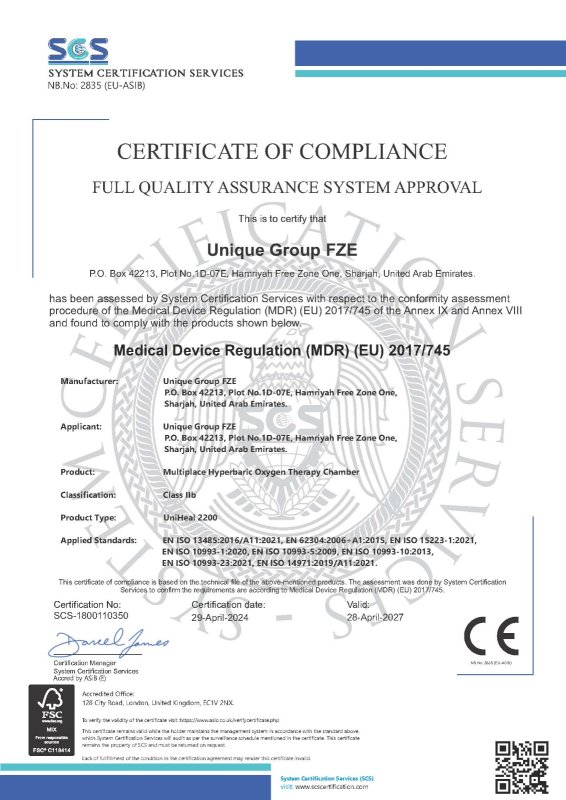
Sample shown for reference only and does not represent certification for every medical device.
CE Marking Certification for Medical Devices with SCS
SCS provides medical-device CE conformity assessment services for organizations in the UAE seeking to demonstrate conformity with applicable European requirements.
Depending on the product and agreed scope, support can include:
- Product and regulatory review
- Medical-device classification review
- MDR applicability assessment
- Technical documentation assessment
- GSPR assessment
- Risk-management evaluation
- Clinical evidence review
- Conformity assessment
- Quality-management assessment where applicable
- CE-marking documentation
- EU Declaration of Conformity review
- Support relating to applicable post-market requirements
The applicable service depends on the device, classification, documentation and conformity assessment route.
Manufacturers can contact SCS with their product details to discuss the appropriate certification pathway.
Request Medical Device CE Certification in UAE
If your company manufactures, imports, exports or develops a medical device in the UAE and requires CE conformity assessment for the European market, SCS can review the product and applicable MDR requirements.
Send the following information for an initial enquiry:
- Product name
- Product description
- Intended purpose
- Product model
- Classification, if known
- Manufacturing location
- Existing certificates
- Technical documentation available
- Test reports
- Clinical evidence, if available
- Target European market
Need CE marking certification for your medical device? Contact SCS for a free certification enquiry.
★★★★★
System Certification Services (SCS)
Dubai, United Arab Emirates
+971 50 302 4312
scs@scscertification.com
Need CE Mark Certification for Your Products?
Speak with our certification specialists to understand certification requirements, audit process, implementation timelines and accredited certification services.