CE Marking Certification for Lifts in UAE | Lift & Elevator Certification | EU Directive 2014/33/EU | SCS
★★★★★
Need CE Marking Certification for Lifts in UAE? SCS supports lift manufacturers, elevator companies, installers, OEMs and exporters with applicable CE conformity assessment requirements.
For a free certification enquiry, contact SCS:
https://www.scscertification.com/contactus.php
CE Marking Certification for Lifts in UAE
CE Marking Certification for Lifts in UAE is relevant to manufacturers, installers, elevator companies, OEMs, safety-component manufacturers and exporters supplying lifts or lift safety components to markets where European CE requirements apply.
Lifts within the scope of the European Union Lifts Directive 2014/33/EU must satisfy the applicable essential health and safety requirements and follow the appropriate conformity assessment procedure before being placed on the EU market.
For UAE-based businesses, CE marking is particularly relevant when passenger lifts, goods lifts, hospital lifts, hydraulic elevators, traction lifts, machine-room-less elevators or applicable lift safety components are manufactured or supplied for European markets.
CE marking should not be understood as a general UAE lift approval. It is a European conformity marking connected to applicable European product legislation.
What Is CE Marking for Lifts?
CE marking for lifts indicates that the applicable conformity requirements under the relevant European legislation have been addressed.
Directive 2014/33/EU establishes requirements for lifts and specified safety components, including essential health and safety requirements, technical documentation, conformity assessment, EU Declaration of Conformity and CE marking.
The responsibility can differ depending on the product.
For a complete lift, the installer assumes responsibility for conformity with the applicable requirements. For specified safety components, the manufacturer assumes responsibility for the conformity of the component.
The CE process can involve:
- Product and regulatory scope assessment
- Risk assessment
- Technical documentation
- Design and engineering review
- Applicable harmonised standards
- Testing and inspection
- Conformity assessment
- Notified-body assessment where required
- EU Declaration of Conformity
- CE marking
There is no single identical CE certification route for every lift.
EU Lifts Directive 2014/33/EU
Directive 2014/33/EU is the European Union legislation concerning the harmonisation of laws relating to lifts and safety components for lifts.
The Directive establishes essential health and safety requirements and conformity assessment procedures applicable to products within its scope.
It addresses areas including:
- Lift design and manufacture
- Installation
- Safety requirements
- Safety components
- Technical documentation
- Conformity assessment
- EU Declaration of Conformity
- CE marking
- Notified-body involvement
- Economic operator responsibilities
For UAE manufacturers exporting lifts to Europe, understanding Directive 2014/33/EU is an important starting point for determining the applicable conformity assessment route.
Which Lifts Can Require CE Certification?
The lift sector covers a wide range of products. Depending on the actual product design, intended use and regulatory scope, CE conformity assessment can apply to products such as:
- Passenger lifts
- Passenger and goods lifts
- Goods and freight lifts
- Hospital and bed lifts
- Hydraulic lifts
- Electric and traction lifts
- Machine-room-less elevators
- Home and residential lifts
- Certain accessibility and platform lifting products
The commercial name of a product does not by itself determine its regulatory classification.
The actual design, speed, intended use, installation arrangement and applicable European legislation should be reviewed before selecting the conformity assessment procedure.
Passenger Lift CE Certification
Passenger lifts are designed primarily to transport people in residential, commercial, hospitality, healthcare and public buildings.
Passenger elevator CE assessment can involve review of the lift car, landing doors, drive system, suspension, braking arrangements, control system, safety devices and other relevant systems.
The applicable conformity assessment procedure depends on the lift and its design.
Goods and Freight Lift CE Certification
Goods and freight lifts are generally designed for transporting materials and goods.
They are used in warehouses, factories, commercial facilities, industrial buildings and other environments.
Whether a particular goods lift falls within the scope of Directive 2014/33/EU should be established from its actual configuration and intended use rather than its commercial description alone.
Hospital and Bed Lift CE Certification
Hospital and bed lifts are designed for healthcare environments where patients, beds, medical equipment and personnel may need to be transported.
Their technical assessment can involve particular consideration of lift dimensions, controls, doors, safety systems and intended use.
The applicable conformity requirements remain dependent on the actual lift design and regulatory scope.
Hydraulic Lift CE Certification
Hydraulic lifts use hydraulic power to move the lift car and are commonly used in low-rise, commercial and industrial applications.
The conformity assessment can involve review of the hydraulic system, safety arrangements, controls, lift structure and other relevant technical characteristics.
Electric and Traction Lift CE Certification
Electric and traction lifts use an electric drive and traction arrangement to move the lift car.
These systems are widely used for passenger and commercial elevators.
Assessment can involve the traction system, drive, braking system, suspension, overspeed protection, controls, doors and other safety functions.
MRL Elevator CE Certification
Machine-room-less elevators integrate the lifting machinery into the shaft or another compact arrangement instead of using a conventional machine room.
MRL elevators can be used in residential, commercial and other buildings.
The MRL designation does not by itself determine the conformity assessment procedure. The complete product and its technical design must be assessed.
Home and Residential Lift CE Certification
Home and residential lifts are designed for private residences and low-rise buildings.
The term "home lift" can describe products with different speeds, capacities, configurations and operating characteristics.
The applicable European legislation should therefore be established from the actual product before determining the CE conformity route.
Accessibility and Platform Lifts
Accessibility and platform lifting products can be used to improve access for people with reduced mobility.
However, not every product marketed as a platform lift automatically follows the same regulatory route as a conventional passenger elevator.
The product design, intended use and applicable European legislation should be reviewed before determining whether Directive 2014/33/EU applies.
Lift Safety Components and CE Certification
Directive 2014/33/EU also identifies specific safety components for lifts.
These include products such as:
- Landing-door locking devices
- Devices preventing falls or uncontrolled movement of the lift car
- Overspeed limitation devices
- Energy-accumulating buffers
- Energy-dissipating buffers
- Certain safety devices fitted to hydraulic jacks
- Specified electrical safety devices
Safety components have their own conformity assessment requirements.
Therefore, CE certification for a lift safety component should not automatically be treated as equivalent to CE certification for a complete lift.
Lift Safety Gear
Safety gear and other fall-prevention arrangements form an important part of lift safety.
Where a product falls within the specified safety-component scope, its design, technical documentation, testing and conformity assessment must be evaluated against the applicable requirements.
Lift Overspeed Governors
Overspeed limitation devices are among the safety components specifically identified under the Lifts Directive.
The applicable conformity assessment must demonstrate that the component meets the relevant requirements for its intended safety function.
Lift Door Locking Devices
Landing-door locking devices are also identified as lift safety components.
Their function is associated with preventing access to the lift shaft when the lift car is not appropriately positioned.
The applicable technical documentation and conformity assessment depend on the component design and regulatory route.
Lift Buffers
Lift buffers can be energy-accumulating or energy-dissipating devices.
The applicable conformity assessment depends on the type and technical characteristics of the buffer.
Lift Conformity Assessment Procedures
Directive 2014/33/EU provides different conformity assessment procedures for lifts and safety components.
Depending on the product and route, these can include:
- EU-type examination
- Final inspection
- Conformity to type based on product quality assurance
- Conformity to type based on production quality assurance
- Unit verification
- Full quality assurance
- Design examination
The correct procedure depends on the lift or safety component and the conformity route selected under the Directive.
EU-Type Examination for Lifts
EU-type examination involves assessment of the technical design of a representative lift or applicable safety component by a notified body.
Technical information can include:
- Product description
- Design drawings
- Manufacturing drawings
- Electrical diagrams
- Explanations of operation
- Risk assessment
- Applicable standards
- Design calculations
- Test information
- Instructions
- Supporting technical specifications
Where applicable, an EU-type examination can form part of a subsequent conformity assessment procedure.
Final Inspection for Lifts
Final inspection is one of the conformity assessment routes available for lifts.
The completed lift is examined and tested against the applicable requirements.
Depending on the procedure, testing can include checks of:
- Lift operation
- Empty and maximum-load operation
- Safety devices
- Power-loss conditions
- Load-related performance
The specific testing requirements depend on the applicable conformity assessment route.
Unit Verification for Lifts
Unit verification is a conformity assessment procedure for an individual lift.
The notified body assesses the individual lift and its technical documentation against the applicable essential health and safety requirements.
This route can be relevant where a lift is being assessed individually rather than through a conventional production/type arrangement.
Lift Quality Assurance
Quality-assurance-based conformity assessment provides another route under the Lifts Directive.
Depending on the selected procedure, assessment can address:
- Design controls
- Manufacturing processes
- Installation
- Inspection
- Testing
- Quality-system controls
- Technical documentation
- Surveillance
The applicable quality-assurance procedure depends on the conformity assessment route.
Lift Technical Documentation
Technical documentation is a central part of lift CE conformity assessment.
Depending on the lift and conformity route, the technical file can include:
- General lift description
- Technical specifications
- Design drawings
- Manufacturing drawings
- Electrical schematics
- Control-system information
- Safety-system information
- Risk assessment
- Design calculations
- Applicable standards
- Test reports
- Safety-component documentation
- Installation information
- Operating instructions
- Maintenance information
- Rescue information
- EU Declaration of Conformity
The documentation should demonstrate how the applicable essential health and safety requirements have been addressed.
Lift Risk Assessment
Risk assessment should correspond to the actual design and intended use of the lift.
Depending on the product, the assessment can consider:
- Uncontrolled movement
- Free fall
- Overspeed
- Door movement
- Crushing
- Trapping
- Mechanical hazards
- Electrical hazards
- Shaft access
- Emergency situations
- Power failure
- Maintenance activities
- Safety-device performance
The identified risks should be addressed through suitable design and protective measures.
EN 81 Standards for Lift CE Certification
EN 81 standards are widely used in lift design and safety assessment.
Depending on the product, manufacturers can encounter standards such as:
- EN 81-20
- EN 81-50
- Other applicable EN 81 standards
Where applicable harmonised standards have references published in the Official Journal of the European Union, their use can provide a presumption of conformity with the essential health and safety requirements covered by those standards.
However, EN 81 compliance by itself should not be presented as a complete CE certification.
The applicable standards must be considered together with the actual lift, applicable legislation and selected conformity assessment procedure.
Lift Safety Requirements
Lift CE conformity involves addressing the applicable essential health and safety requirements.
Depending on the lift, these can include requirements concerning:
- Protection against crushing
- Protection against falling
- Landing doors
- Lift-car doors
- Control systems
- Emergency functions
- Overspeed protection
- Mechanical safety
- Electrical safety
- Maintenance access
- Rescue operations
- Lighting
- Safety information
- Rated load
- Passenger capacity
The requirements applicable to a particular lift depend on its design and scope.
Lift Labelling and Instructions
Lifts must carry the applicable identification and safety information.
The Lifts Directive includes requirements concerning information such as rated load and maximum passenger capacity.
Instructions can address:
- Normal operation
- Maintenance
- Inspection
- Repair
- Periodic checks
- Rescue operations
- Technical information
- Safety procedures
Safety components also require appropriate instructions for assembly, connection, adjustment and maintenance where applicable.
EU Declaration of Conformity for Lifts
The EU Declaration of Conformity is an important part of the CE process.
For a complete lift, the installer assumes responsibility for conformity with the applicable requirements.
For a safety component, the manufacturer assumes the corresponding responsibility.
The declaration identifies the applicable legislation and confirms that the relevant conformity requirements have been fulfilled.
CE Marking Requirements for Lifts
CE marking is applied after completion of the applicable conformity assessment process.
The CE marking must be visible, legible and indelible.
For lifts, the CE marking is affixed to the lift car.
For applicable safety components, CE marking is placed on the component or, where that is not possible, on an inseparably attached label.
Where the conformity assessment procedure involves a notified body, the notified body's identification number follows the CE marking where required.
CE marking should therefore be viewed as the result of conformity assessment rather than as a standalone certificate.
Sample Lift CE Certificate
A sample lift CE certificate or conformity document can help manufacturers understand how conformity documentation may be presented.
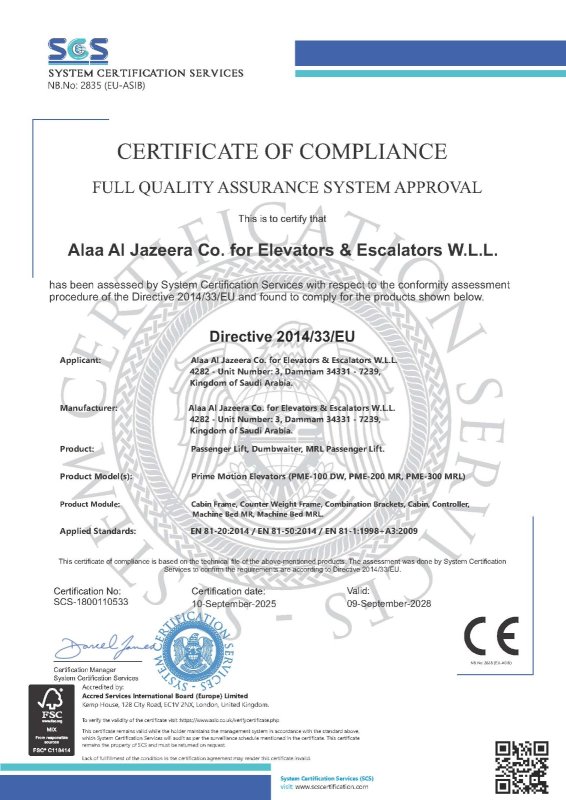
Sample shown for reference only. Actual documentation depends on the lift, safety component, conformity assessment procedure and applicable European requirements.
CE Marking Certification Process for Lifts in UAE
The CE certification process for a UAE-based lift manufacturer can generally be approached through the following stages:
1. Product Review
Identify the lift type, model, intended use, rated capacity and technical configuration.
2. Regulatory Scope Assessment
Determine whether the product falls within Directive 2014/33/EU and identify applicable exclusions.
3. Standards Review
Identify relevant harmonised standards and other technical specifications.
4. Technical Documentation Review
Review drawings, calculations, electrical information, safety systems, risk assessment, manuals and existing test evidence.
5. Conformity Assessment Route
Select the applicable conformity assessment procedure.
6. Testing and Inspection
Complete applicable testing, inspection, examination or quality-system assessment.
7. Conformity Documentation
Complete the applicable conformity documentation and EU Declaration of Conformity.
8. CE Marking
Apply the CE marking and notified-body identification number where required.
9. Compliance Maintenance
Maintain technical documentation and applicable conformity records.
The exact process varies between different lift products and safety components.
Lift CE Certification Cost in UAE
There is no fixed cost applicable to every lift CE certification project.
The assessment cost can depend on:
- Lift type
- Product complexity
- Number of models
- Technical documentation
- Testing requirements
- Inspection requirements
- Selected conformity assessment procedure
- Safety components
- Quality-system requirements
- Notified-body involvement
A complete passenger elevator and a standardised safety component can have substantially different assessment scopes.
For this reason, SCS can review the product details before providing a certification quotation.
How Long Does Lift CE Certification Take?
The timeframe depends on the product and the selected conformity assessment route.
Factors that can affect the timeline include:
- Completeness of technical documentation
- Technical complexity
- Availability of test reports
- Applicable testing
- Type examination
- Inspection
- Quality-system assessment
- Number of models
- Corrective actions
A manufacturer with a complete technical file can move through assessment more efficiently than one developing its documentation during the certification process.
Lift CE Certification in Dubai
Dubai-based lift manufacturers, elevator companies, engineering organizations and exporters can seek CE conformity assessment support for applicable products intended for European markets.
SCS supports certification enquiries from organizations operating across Dubai and its industrial and commercial areas.
Lift CE Certification in Abu Dhabi
Manufacturers and engineering companies operating in Abu Dhabi can also require CE conformity assessment for applicable lifts and safety components intended for European markets.
SCS supports enquiries from companies operating in Abu Dhabi, Mussafah, ICAD, KIZAD and Al Ain.
Lift CE Certification Across UAE
SCS supports CE certification enquiries from companies throughout the UAE, including:
- Dubai
- Abu Dhabi
- Sharjah
- Ajman
- Ras Al Khaimah
- Fujairah
- Umm Al Quwain
- Al Ain
The applicable European conformity requirements depend on the product and intended market rather than the emirate in which the manufacturer operates.
CE Certification for UAE Lift Manufacturers and Exporters
UAE-based manufacturers exporting lifts to Europe may need to address:
- Directive 2014/33/EU
- Essential health and safety requirements
- Applicable harmonised standards
- Risk assessment
- Technical documentation
- Testing
- Conformity assessment
- Notified-body assessment where required
- EU Declaration of Conformity
- CE marking
CE conformity should be considered during product design rather than only after the lift has been manufactured.
Existing Lifts and Lift Modernisation
Modernisation can involve changes to:
- Controllers
- Drive systems
- Doors
- Safety gears
- Overspeed governors
- Buffers
- Electrical safety circuits
- Lift cars
- Control systems
- Safety functions
The effect of a modification on conformity should be assessed according to the actual technical change.
An existing CE document should not automatically be assumed to cover a substantially modified lift.
Local Lift Approval vs CE Conformity
CE conformity and local UAE lift requirements are separate matters.
CE marking relates to applicable European product legislation.
Local installation approval, inspection, testing, operation and maintenance requirements can arise separately from UAE authorities, building regulations, project requirements or other applicable rules.
A lift supplied to a UAE building can therefore have local requirements even when the same product is also being prepared for the European market.
Lifts Excluded from Directive 2014/33/EU
Not every lifting product is covered by the EU Lifts Directive.
The Directive contains exclusions covering certain products and applications, including:
- Certain lifting appliances operating at 0.15 m/s or less
- Construction-site hoists
- Cableways
- Certain military or police lifting appliances
- Mine winding gear
- Lifting appliances fitted in means of transport
- Certain machinery access lifting appliances
- Rack and pinion trains
- Escalators
- Mechanical walkways
The actual product and intended use must therefore be assessed before determining the applicable European legislation.
Common Lift CE Certification Problems
Manufacturers can face avoidable delays when conformity requirements are considered only after product development.
Common issues include:
- Incorrect regulatory scope
- Incomplete technical documentation
- Missing risk assessment
- Incorrect standards
- Insufficient testing evidence
- Incomplete engineering drawings
- Inconsistent product specifications
- Incorrect conformity assessment route
- Missing safety-component documentation
- Incorrect CE marking
- Incomplete EU Declaration of Conformity
- Assuming an existing certificate covers modifications
- Treating local inspection as European CE conformity
Early assessment can help identify these issues before the formal conformity process.
Why Choose SCS for Lift CE Certification in UAE?
System Certification Services (SCS) supports UAE-based manufacturers, elevator companies, installers, OEMs, safety-component manufacturers and exporters with applicable CE conformity assessment requirements.
SCS can support enquiries involving:
- Passenger lifts
- Goods and freight lifts
- Hospital lifts
- Hydraulic lifts
- Electric and traction lifts
- MRL elevators
- Residential lifts
- Applicable accessibility lifts
- Lift safety components
The actual certification scope depends on the product, technical documentation and applicable conformity assessment procedure.
CE Marking Certification for Lifts in UAE – SCS
For lift manufacturers, the most important part of CE conformity is establishing the correct regulatory route for the actual product.
A passenger elevator, hydraulic lift, goods lift, MRL elevator and lift safety component should not automatically be treated as having the same certification requirements.
SCS supports manufacturers and exporters with the applicable technical and conformity assessment requirements for lifts and safety components.
Need CE Marking Certification for Lifts in UAE?
For a free certification enquiry, contact SCS:
https://www.scscertification.com/contactus.php
System Certification Services (SCS)
Dubai, United Arab Emirates
+971 50 302 4312
scs@scscertification.com
Need CE Mark Certification for Your Products?
Speak with our certification specialists to understand certification requirements, audit process, implementation timelines and accredited certification services.