CE Certification for Structural Bolting Assemblies in UAE | EN 14399 Certification | SCS
Need EN 14399 certification or CE marking for structural bolting assemblies in the UAE? Contact SCS for a free certification enquiry.
★★★★★
CE Certification for Structural Bolting Assemblies in UAE
Structural bolting assemblies are a small part of a steel structure, but their performance has a direct bearing on the reliability of the connection. High-strength bolts, nuts and washers used in preloaded structural joints need to be manufactured, matched, identified and controlled consistently.
For UAE manufacturers supplying structural fasteners to European customers, international EPC contractors, steel fabricators or projects based on European standards, EN 14399 certification can be an important requirement.
The EN 14399 series covers high-strength structural bolting assemblies for preloading. Depending on the applicable product and conformity-assessment route, manufacturers may need to demonstrate effective Factory Production Control, material traceability, product testing, dimensional control, surface-treatment control and other specified characteristics.
For companies searching for CE certification for structural bolts in UAE, the first step is to establish whether the product falls within an applicable European construction-product conformity route. CE marking is not a substitute for product assessment, and EN 14399 should not be treated as a blanket legal requirement for every structural fastener sold in the UAE.
What Is EN 14399 Certification?
EN 14399 is a European standard series for high-strength structural bolting assemblies for preloading.
The standard family addresses structural bolting systems designed to provide controlled performance in preloaded connections. Different parts of the series apply to different assembly systems and component arrangements.
For a manufacturer, EN 14399 certification can therefore involve much more than checking the dimensions of a bolt. The complete product configuration needs to be considered, including the bolt, nut, washer, material, grade, dimensions, surface condition and relevant manufacturing controls.
This is why EN 14399 certification in UAE is particularly relevant to manufacturers supplying structural fasteners for demanding construction and infrastructure applications.
What Are Structural Bolting Assemblies?
A structural bolting assembly is a defined combination of components used to make structural connections.
Depending on the applicable system, this may include:
- High-strength structural bolts
- Matching nuts
- Washers
- Defined surface finishes
- Components manufactured to the relevant product requirements
The components are not necessarily interchangeable. The bolt, nut and washer combination must correspond to the applicable structural bolting system.
This distinction is important when a manufacturer is developing its structural bolting assembly certification scope.
Which Products Are Covered by EN 14399?
The EN 14399 family contains several parts addressing high-strength structural bolting assemblies for preloading.
Depending on the product, relevant parts can include:
- EN 14399-1 – General requirements
- EN 14399-2 – Suitability for preloading
- EN 14399-3 – HR system
- EN 14399-4 – HV system
- EN 14399-5 – HRD system
- EN 14399-6 – HRC system
The appropriate standard and product system depend on the actual assembly being manufactured.
A manufacturer producing several bolt sizes, grades or finishes should establish which configurations are included within its certification scope.
Is CE Marking Required for Structural Bolts in the UAE?
There is no general UAE rule requiring every structural bolt manufacturer to apply CE marking.
CE marking becomes relevant when the product falls within an applicable European regulatory and conformity-assessment framework. It can also be requested contractually by an international customer, consultant, contractor or project.
Therefore, CE marking for structural bolts should be considered in relation to:
- Product scope
- Applicable harmonised technical specification
- Intended European market
- Applicable AVCP system
- Third-party conformity-assessment requirements
- Manufacturer's declared performance
- Technical documentation
A UAE project specification can also request CE marking without turning that project requirement into a universal UAE legal obligation.
Is EN 14399 Certification Mandatory in the UAE?
EN 14399 certification is not automatically mandatory for every structural fastener manufacturer in the UAE.
A requirement may instead originate from:
- European market-access requirements
- Construction-product regulations
- International project specifications
- Consultant requirements
- EPC contractor requirements
- Client approval procedures
- Customer specifications
- Export contracts
- Procurement requirements
This distinction is particularly important for UAE manufacturers. A company should identify the actual requirement before investing in a certification route.
EN 14399 Certification Requirements
The exact EN 14399 certification requirements depend on the product system and applicable conformity-assessment route.
A manufacturer may need controls covering:
- Raw materials
- Material certificates
- Manufacturing processes
- Bolt dimensions
- Nut and washer dimensions
- Mechanical properties
- Surface treatment
- Product marking
- Batch identification
- Traceability
- Inspection
- Testing
- Non-conforming products
- Calibration
- Production records
- Factory Production Control
The certification scope should correspond to what the manufacturer actually produces.
Factory Production Control for Structural Bolting
Factory Production Control, commonly called FPC, is a key part of demonstrating consistent production.
For structural fastener manufacturers, FPC can cover the complete production chain, from incoming materials through final product release.
Typical controls may include:
- Supplier approval
- Incoming material inspection
- Heat-number control
- Batch identification
- Material certificate verification
- Production-process control
- Dimensional inspection
- Mechanical testing
- Surface-treatment control
- Marking
- Packaging
- Storage
- Final inspection
- Non-conformity control
- Record keeping
An effective FPC system should reflect the manufacturer's actual operations. It should not simply consist of procedures prepared for an audit.
Why Material Traceability Matters
Material traceability is particularly important for high-strength structural fasteners.
A manufacturer should be able to establish where the raw material originated and connect it with the relevant production batch and finished product.
A typical traceability chain can be:
Raw material → heat/batch → production → inspection/testing → finished assembly → delivery
Good traceability helps manufacturers demonstrate consistent production and respond efficiently to customer documentation requests or quality investigations.
It can also be important during supplier approval for large construction and infrastructure projects.
Bolt, Nut and Washer Compatibility
Structural bolting assemblies are designed around defined component combinations.
The manufacturer should control the relationship between:
- Bolt
- Nut
- Washer
- Product system
- Grade
- Dimensions
- Surface finish
- Marking
A bolt certified under one configuration should not automatically be combined with an unrelated nut or washer and represented as the same certified assembly.
This is one reason why structural fastener certification in UAE requires a clearly defined product scope.
What Bolt Sizes Can Be Certified?
The applicable EN 14399 product standards cover different nominal sizes and configurations.
A manufacturer's certification scope can potentially include multiple sizes, provided the applicable requirements are adequately assessed and the production-control system covers those products.
Certification of one bolt size does not automatically mean that every size manufactured by the company is covered.
SCS can review the proposed size range before certification to establish an appropriate scope.
Can Galvanised Structural Bolts Be Certified?
Yes, where the relevant product requirements permit the surface finish and the configuration is included within the applicable certification scope.
Structural bolting assemblies can be supplied with finishes such as:
- Self-colour
- Hot-dip galvanised
- Sherardised
- Zinc-plated
- Other permitted finishes
Surface treatment is important because surface characteristics can affect the behaviour of preloaded connections. The treatment process therefore needs appropriate control.
Why Preloading Is Important
Preloading introduces a defined tensile force into the structural bolt during installation.
The performance of the connection can be influenced by:
- Bolt properties
- Nut properties
- Washer configuration
- Surface condition
- Friction characteristics
- Installation method
- Required preload
- Connection design
This is why EN 14399 products are different from ordinary commercial fasteners.
For manufacturers targeting high-strength structural bolts in UAE markets, understanding the intended structural application is essential when establishing the certification scope.
What Testing Is Required?
Testing depends on the applicable EN 14399 product part and conformity-assessment requirements.
Depending on the product, assessment may address characteristics such as:
- Tensile performance
- Proof load
- Hardness
- Dimensions
- Bolt properties
- Nut properties
- Washer properties
- Suitability for preloading
- Surface condition
- Coating characteristics
- Assembly behaviour
The appropriate testing programme should be established against the applicable product requirements.
Can Existing Test Reports Be Used?
Existing test reports may be useful if they are technically relevant and acceptable for the applicable certification route.
However, a test report for an ordinary commercial fastener should not automatically be considered sufficient evidence for an EN 14399 structural bolting assembly.
SCS can review available reports during the initial scope assessment.
Documents Required for Structural Bolting Certification
Manufacturers may need to provide:
- Company information
- Factory details
- Product catalogue
- Product specifications
- Bolt specifications
- Nut specifications
- Washer specifications
- Material certificates
- Manufacturing procedures
- Factory Production Control documents
- Inspection procedures
- Testing procedures
- Traceability records
- Batch records
- Surface-treatment information
- Calibration records
- Product marking information
- Existing test reports
- Technical documentation
- Non-conformity procedures
The final document requirements depend on the product and certification scope.
EN 14399 Certification Process in UAE
1. Product Scope Review
SCS reviews the manufacturer's bolt, nut and washer products, dimensions, grades, product systems and finishes.
2. Applicable Requirements
The relevant EN 14399 product parts and conformity-assessment requirements are identified.
3. FPC Review
The existing Factory Production Control system is reviewed against the applicable requirements.
4. Production Assessment
Manufacturing processes, material controls, testing, inspection, identification and traceability are assessed.
5. Factory Assessment
The production facility and relevant FPC arrangements are evaluated.
6. Corrective Actions
Any identified nonconformities are addressed by the manufacturer.
7. Certification
Once the applicable requirements have been satisfactorily demonstrated, certification can proceed within the defined scope.
8. Continuing Surveillance
Where required by the applicable conformity-assessment scheme, surveillance activities verify that the manufacturer's production controls continue to meet the relevant requirements.
CE Certification for Structural Bolting Assemblies in Dubai
Dubai has a substantial structural-steel fabrication and construction supply chain.
Manufacturers in Jebel Ali, Dubai Investment Park, Al Quoz and other industrial areas may supply structural fasteners to steel fabricators, EPC contractors, infrastructure companies and international customers.
For these manufacturers, CE certification for structural bolting assemblies in Dubai may become relevant when European conformity requirements, international customer specifications or project documentation call for it.
SCS can assess eligible manufacturers in Dubai seeking applicable EN 14399 conformity assessment.
EN 14399 Certification in Abu Dhabi
Abu Dhabi's industrial sector includes manufacturers and suppliers serving construction, infrastructure, energy and engineering projects.
Companies operating in Mussafah, ICAD and other industrial locations may encounter EN 14399 requirements through international contracts, consultant specifications, customer approvals and project procurement requirements.
SCS can support eligible manufacturers seeking EN 14399 certification in Abu Dhabi and can review the proposed product scope before assessment.
Structural Fastener Certification Across the UAE
EN 14399 enquiries are not limited to Dubai and Abu Dhabi.
Manufacturers in:
- Sharjah
- Ajman
- Ras Al Khaimah
- Fujairah
- Umm Al Quwain
can also assess whether structural fastener certification is appropriate for their products and intended markets.
The relevant certification route depends on the product rather than simply the Emirate in which the factory operates.
EN 14399 and UAE Infrastructure Projects
Large UAE developments such as Dubai Metro, Etihad Rail and other major transport, industrial and commercial projects have contributed to a construction environment where controlled structural connections, documented manufacturing processes, qualified production personnel and traceable components can be commercially important.
For structural fastener manufacturers, requirements relating to EN 14399, CE marking where applicable, mechanical performance, preloading, Factory Production Control and material traceability may therefore arise in project specifications and procurement processes.
These projects should not, however, be presented as creating a blanket UAE legal requirement for EN 14399 certification. The actual obligation may come from a project specification, consultant, contractor, client approval process or contract.
EN 14399 for International Projects
UAE manufacturers increasingly work with international contractors and engineering companies.
A customer may specify EN 14399 when procuring structural bolting assemblies for:
- Steel buildings
- Industrial structures
- Bridges
- Rail infrastructure
- Transport projects
- Commercial developments
- International EPC projects
- Export construction projects
For manufacturers targeting the European market, EN 14399 certification may form part of the required conformity-assessment route where the applicable European requirements apply.
Certification does not automatically guarantee acceptance for every project. Project-specific technical and procurement requirements still need to be satisfied.
EN 14399 and EN 1090
EN 14399 and EN 1090 address different parts of structural steel construction.
EN 1090 is associated with applicable structural steel and aluminium components and their execution and conformity assessment.
EN 14399 concerns high-strength structural bolting assemblies for preloading.
In a typical steel construction supply chain:
Structural steel components → EN 1090
High-strength structural bolting assemblies → EN 14399
This makes EN 14399 a natural complementary certification area for manufacturers already serving the structural steel sector.
Can EN 1090 Replace EN 14399 Certification?
No.
EN 1090 certification for structural steel components does not automatically demonstrate conformity of high-strength structural bolting assemblies.
Similarly, EN 14399 certification does not replace applicable requirements for fabricated structural steel components.
Where both products are used on a project, each should satisfy the requirements applicable to its own product category.
SCS Certified Companies for CE and European Conformity
SCS has provided certification and conformity-assessment services for companies across different CE and European regulatory product categories.
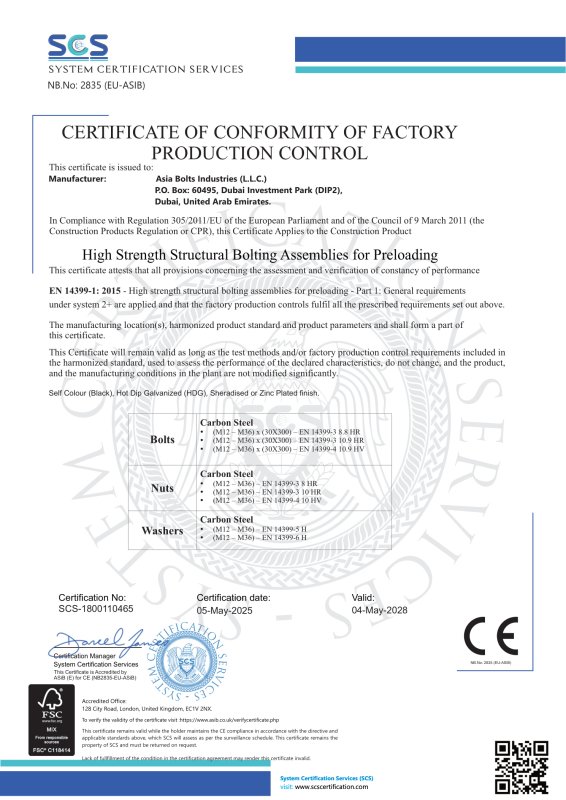
Asia Bolts Industries (L.L.C.)
Product: High Strength Structural Bolting Assemblies for Preloading
Standard: EN 14399-1:2015
Regulation: 305/2011/EU
Location: Dubai Investment Park, Dubai
Notified Body: NB No. 2835 (EU-ASIB)
Certificate No.: SCS-1800110465
The certification scope identifies carbon-steel bolts, nuts and washers in specified dimensions and finishes, with applicable EN 14399 product parts included within the certified scope.
Other Companies Certified by SCS for CE / European Requirements
Examples from SCS certification activities include:
- Asia Bolts Industries (L.L.C.) — High-strength structural bolting assemblies for preloading
- Traverse International Insulation Materials LLC — Construction products under applicable CPR requirements
- Rollstud Middle East Inc. — Construction products under applicable CPR requirements
- Specialized Factory for Steel Products — Construction products under applicable CPR requirements
- Almasa Environmental Industries LLC — Construction products under applicable CPR requirements
- DYOTA ENGINEERED SOLUTIONS L.L.C — Construction products under applicable CPR requirements
- Faham Doors Industries Co. L.L.C — Construction products under applicable CPR requirements
- Onground Hospitality LLC — Construction products under applicable CPR requirements
- VALVEIT S.r.l. — Applicable CE conformity assessment under the Pressure Equipment Directive
- Cycled Technologies AS — Applicable CE conformity assessment for machinery
These companies represent different product categories and European conformity routes. The list should not be interpreted as stating that every company listed holds EN 14399 certification. Asia Bolts Industries is the structural bolting example specifically relevant to this article.
SCS for EN 14399 Certification in UAE
SCS provides applicable product certification and conformity-assessment services for manufacturers seeking to demonstrate conformity with defined European and international requirements.
SCS is accredited by ASIB (Europe) under applicable product-certification activities and operates as EU-ASIB Notified Body No. 2835 for applicable conformity-assessment activities within its notified scope.
For structural fastener manufacturers, the assessment begins with the product and intended market rather than with a predetermined certificate.
This helps ensure that the proposed certification scope corresponds to the actual products manufactured by the company.
What Is the Cost of EN 14399 Certification in UAE?
There is no standard price for every manufacturer.
The cost of EN 14399 certification in UAE can depend on:
- Number of product systems
- Bolt sizes
- Grades
- Nut and washer configurations
- Surface finishes
- Manufacturing processes
- Factory size
- Existing FPC arrangements
- Existing testing facilities
- Available technical documentation
- Number of manufacturing locations
- Required assessment activities
SCS can review the proposed product scope and provide a quotation based on the manufacturer's requirements.
How Long Does EN 14399 Certification Take?
The timeline varies according to the manufacturer's preparation and certification scope.
Factors that can affect the timeframe include:
- Product range
- FPC readiness
- Testing arrangements
- Traceability systems
- Documentation
- Factory assessment scheduling
- Corrective actions
- Technical review requirements
Manufacturers with established production controls and complete records can generally prepare for assessment more efficiently.
Can ISO 9001 Replace EN 14399 Certification?
No.
ISO 9001 is a quality management-system standard. EN 14399 certification addresses product-specific requirements for applicable high-strength structural bolting assemblies.
An ISO 9001 system can provide a useful management foundation, but it does not automatically establish conformity with EN 14399.
Can Existing Fastener Certifications Be Used?
Existing fastener certificates can provide supporting information, but their applicability needs to be reviewed.
A certificate covering ordinary commercial fasteners does not automatically establish conformity for a high-strength structural bolting assembly for preloading.
The product system, component combination, dimensions, grades and surface finish all need to be considered.
Can One Certification Cover Multiple Bolt Sizes?
Potentially, yes.
Multiple sizes and configurations can be included where the applicable requirements are adequately assessed and the manufacturer's FPC controls cover those products.
The final scope should accurately reflect the products assessed and manufactured.
What Happens If the Manufacturer Adds a New Product?
Adding a new bolt size, grade, product system, surface finish or component combination may require a certification-scope review.
Manufacturers should consult the certification body before representing a new configuration as part of an existing certified scope.
What If My Customer Requests EN 14399 Certification?
Ask the customer to provide the exact technical or procurement requirement.
The customer may be requesting:
- EN 14399 compliance
- CE marking
- A Factory Production Control certificate
- A notified-body certificate
- Product test reports
- Material certificates
- Traceability documentation
- A specific bolt system
- Specific dimensions
- A particular surface finish
SCS can review the requirement and help identify the applicable certification route.
Can EN 14399 Certification Help With Tender Approvals?
It can provide documented evidence of conformity and controlled production when EN 14399 certification or related documentation is specified in tender requirements.
This may help manufacturers demonstrate:
- Product conformity
- Manufacturing controls
- Traceability
- Testing
- Factory Production Control
- Third-party assessment where applicable
- Technical documentation
However, certification does not guarantee tender acceptance. The specific procurement requirements of the project remain applicable.
How Do I Get EN 14399 Certification for Structural Bolts in UAE?
Start by providing SCS with information about:
- Company name
- Factory location
- Product catalogue
- Bolt sizes
- Bolt grades
- Nut and washer combinations
- Product systems
- Surface finishes
- Manufacturing processes
- Existing certifications
- Existing test reports
- FPC documentation
- Intended market
- Customer specifications
- Project requirements
SCS can review the information, identify the proposed certification scope and discuss the applicable assessment process.
Get EN 14399 Certification for Structural Bolting Assemblies With SCS
If your company manufactures high-strength structural bolts, nuts and washers for preloaded structural connections, SCS can review your product range and determine the applicable conformity-assessment requirements.
Whether you are preparing for:
- European market access
- CE marking for structural bolts
- EN 14399 certification
- Structural fastener certification
- An international EPC project
- A steel fabrication tender
- Consultant approval
- Customer qualification
- Factory Production Control assessment
the first step is to establish the correct product scope.
Contact SCS for an EN 14399 certification enquiry and discuss your structural bolting requirements.
SCS UAE Office
System Certification Services (SCS)
6th Floor, Salaam Building
Office 9, Al Marakib Street
Al Danah, Zone 1
Abu Dhabi, United Arab Emirates
Phone: +971 50 302 4312
Email: scs@scscertification.com
SCS provides applicable certification and conformity-assessment services to eligible manufacturers across the UAE, including Dubai, Abu Dhabi, Sharjah, Ajman, Ras Al Khaimah, Fujairah and Umm Al Quwain.
Need ISO Certification for Your Business?
Speak with our certification specialists to understand certification requirements, audit process, implementation timelines and accredited certification services.