
ISO 27001 Audit Evidence: Practical Examples, Records and Common Gaps
Introduction
Preparing for an ISO 27001 audit is not simply about collecting policies and placing them in a folder.
An auditor may want to understand how information security is managed in practice. This can involve reviewing a risk assessment, checking access permissions, examining incident records or asking how the organization verifies that a backup can be restored.
For many organizations, the difficulty is not that nothing has been implemented. It is that evidence is scattered across departments, systems and employees.
This guide explains common ISO 27001 audit evidence examples, the records an organization may need to maintain, and the gaps that can create problems during certification.
The examples are practical illustrations rather than a universal checklist. Evidence requirements depend on the organization's ISMS scope, risks, applicable requirements and selected controls.
ISO 27001 audit evidence examples showing organized information security records and documentation.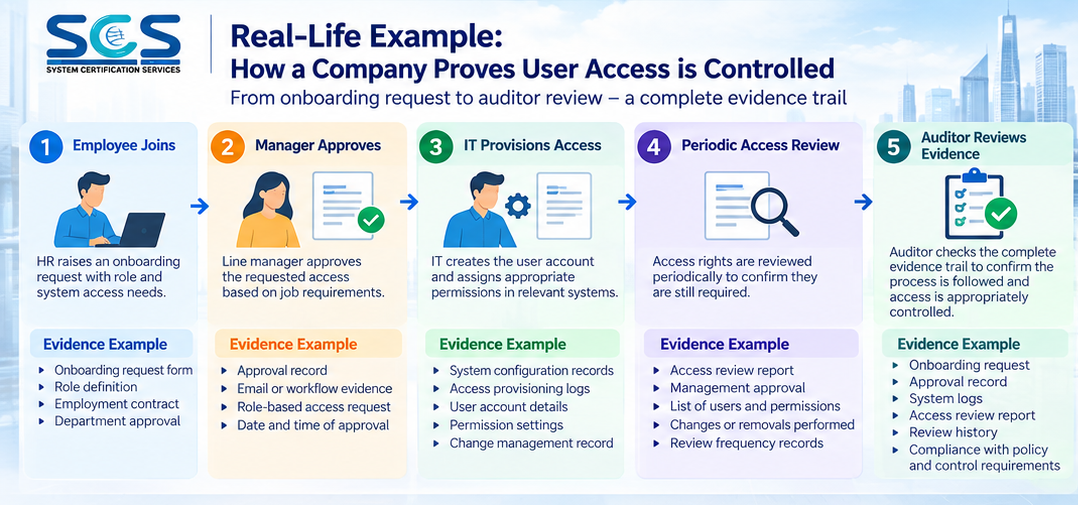
What Is ISO 27001 Audit Evidence?
ISO 27001 audit evidence is information that an auditor can examine to determine whether an organization's Information Security Management System (ISMS) meets applicable requirements and operates as intended.
Evidence may include:
-
Approved policies and procedures
-
Risk assessments and risk treatment records
-
Access-control reports
-
Employee awareness records
-
Internal audit reports
-
Management review minutes
-
Incident records
-
Backup and recovery test results
-
Supplier assessments
-
Corrective action records
-
System-generated logs and reports
A document alone does not necessarily demonstrate that a process is working.
For example, an access-control policy may state that access is reviewed periodically. The auditor may also request a completed access review, evidence of approvals and records showing how unnecessary access was removed.
The important distinction is between describing a process and demonstrating that it is being followed.
ISO 27001 Audit Evidence Checklist
The following table provides a practical starting point for preparing an ISMS evidence register.
| Evidence area | Examples of records |
|---|---|
| ISMS scope | Scope statement, locations, services and boundaries |
| Context | Internal and external issues, interested-party requirements |
| Leadership | Information-security policy, responsibilities and approvals |
| Risk assessment | Risk methodology, risk register and assessment results |
| Risk treatment | Risk treatment plan and implementation status |
| Statement of Applicability | Applicable controls, exclusions and justification |
| Competence and awareness | Training records, awareness sessions and assessments |
| Operational controls | Procedures, operating records and approvals |
| Access management | User access approvals, reviews and removal records |
| Incident management | Incident reports, investigation and corrective actions |
| Business continuity | Backup records, recovery tests and continuity arrangements |
| Internal audit | Audit programme, reports and findings |
| Management review | Meeting records, decisions and action tracking |
| Improvement | Nonconformities, corrective actions and effectiveness checks |
The organization should maintain documented information required by the standard and retain other records where necessary to demonstrate effective operation.
ISO 27001 audit evidence checklist covering risk assessment, access control, incidents, backups and internal audits.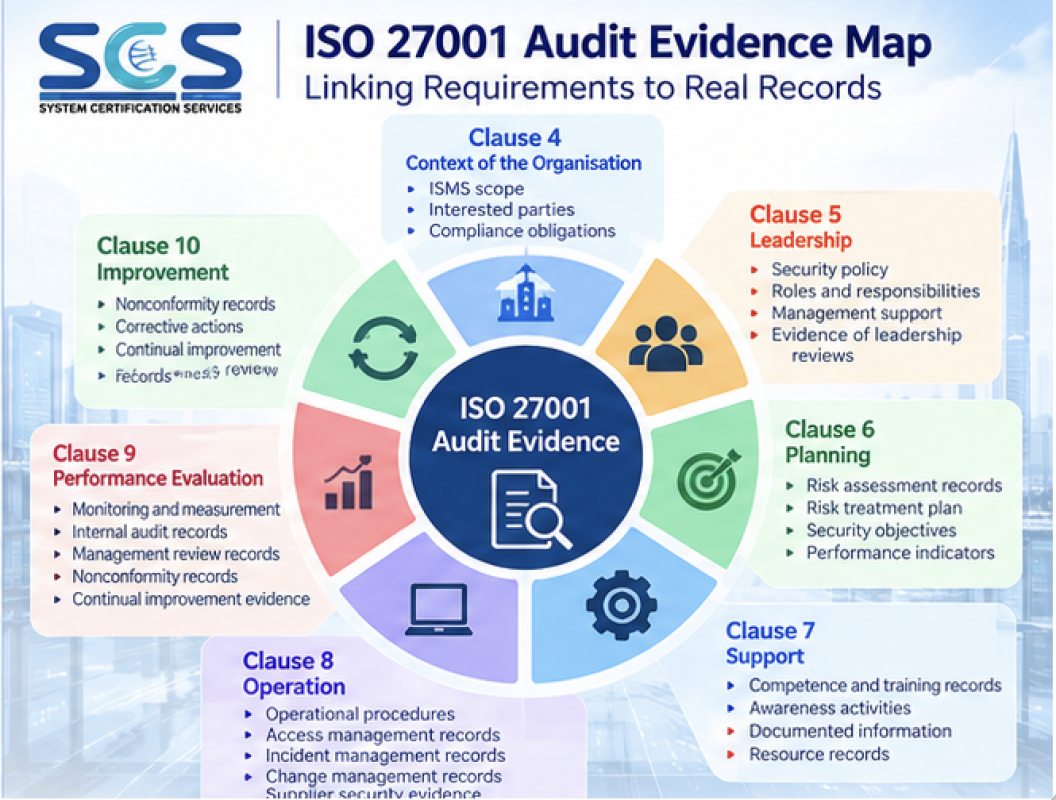
Practical ISO 27001 Audit Evidence Examples
Risk Assessment and Risk Treatment
Risk assessment is one of the central activities within an ISMS.
An auditor may review:
-
The approved risk assessment methodology
-
Identified information-security risks
-
Risk owners
-
Risk evaluation results
-
Risk treatment decisions
-
Residual risk
-
Risk acceptance approvals
-
Review and update records
Practical example: A company identifies unauthorized access to customer information as a risk. Its records may show the risk rating, selected treatment, responsible owner, relevant controls and subsequent review.
A risk register that has not been updated after significant business or technology changes may require further attention.
For organizations seeking broader implementation information, see ISO 27001 consultancy in UAE.
Statement of Applicability (SoA)
The Statement of Applicability identifies the controls determined by the organization to be necessary, their implementation status and the justification for inclusion or exclusion, as applicable.
Evidence may include:
-
Current approved SoA
-
Control applicability decisions
-
Exclusion justifications
-
Implementation status
-
Links to relevant procedures or records
-
Approval and review history
Practical example: If access control is applicable, the SoA may refer to the organization's access management procedure and supporting access review records.
The SoA should reflect actual decisions and implementation status, not simply reproduce a generic template.
1(A)
Access Control Records
Access-control evidence should connect an authorised business need with the permissions actually granted, reviewed and removed. A policy explains the intended process; operating records help demonstrate whether it works.
Useful evidence may include:
• Access requests, business reasons and approvals.
• Permissions actually assigned in the relevant systems.
• Changes following a transfer or change of responsibilities.
• Departure notifications and account-disablement records.
• Reviews of privileged, temporary and emergency access.
• Service-account ownership, purpose and permissions.
• Exceptions identified during reviews and the resulting actions.
Check the systems covered by the records. Disabling a central identity may not remove a separate application account, supplier login or locally managed administrator account.
Illustrative example: A contractor leaves a support assignment. The organisation disables the central account but discovers that the contractor can still access a backup console through a local account. It removes that access, evaluates whether it was used and checks whether other departing contractors were affected by the same gap.
The useful evidence connects the departure notification, account histories, investigation and follow-up. A completed departure checklist alone may not explain what happened in each affected system.
For periodic access reviews, identify the systems, account population, permissions examined and review date. Record exceptions and resulting changes so the original finding remains distinguishable from its correction. Protect sensitive account information and avoid placing passwords or secret values in an audit-evidence folder.
These are examples, not a universal form or prescribed review frequency. Determine suitable arrangements through the organisation’s risks and applicable requirements. For the decisions behind necessary controls, see the ISO 27001 risk assessment, risk treatment and Statement of Applicability guide.
Information Security Awareness and Training
Organizations need to address information-security awareness and competence relevant to their ISMS.
Evidence may include:
-
Training plans
-
Attendance records
-
Awareness materials
-
Assessment results
-
Employee acknowledgements
-
Role-specific training records
-
Follow-up actions where gaps are identified
Practical example: Employees receive phishing-awareness training. The organization retains attendance or completion information and may use an assessment or awareness exercise to identify areas requiring further attention.
Incident Management Records
Incident evidence should demonstrate how the organization identifies, reports, assesses, responds to and learns from information-security events and incidents.
Records may include:
-
Incident reports
-
Incident classification
-
Investigation notes
-
Response actions
-
Escalation records
-
Communication records
-
Root-cause analysis, where appropriate
-
Corrective actions
-
Lessons learned
Practical example: A suspected phishing email is reported. The organization records the assessment, response, relevant containment steps and any follow-up awareness action.
If no incidents have occurred during a period, organizations should not create fictional incident reports. They can instead demonstrate the established reporting process, awareness arrangements and other applicable evidence.
Backup and Recovery Evidence
Backup records can demonstrate that backup arrangements are operating, but a successful backup alone does not establish that recovery will work.
Depending on the organization's arrangements, evidence may include:
-
Backup schedules
-
Backup completion reports
-
Monitoring and failure alerts
-
Retention arrangements
-
Restore-test records
-
Recovery results
-
Issues identified during testing
-
Corrective actions
Practical example: A company performs a restore test for a selected system. The record identifies the test date, system, outcome, issues and any follow-up actions.
1(B)
Supplier and Third-Party Security
Supplier-security evidence should explain the service being provided, the information or access involved and the responsibilities retained by your organisation. A signed contract or supplier certificate is useful supporting information, but neither demonstrates that every relevant responsibility has been addressed.
Depending on the service and associated risks, useful evidence may include:
• Supplier selection, security assessment and approval decisions.
• Contractual security requirements and allocated responsibilities.
• Relevant assurance information and the outcome of its review.
• Customer-controlled configuration and access arrangements.
• Incident contacts, notification terms and escalation responsibilities.
• Service reviews, identified exceptions and follow-up.
• Data return, disposal and access withdrawal when the service changes or ends.
For cloud services, establish who controls identities, application settings, information, backups and incident response. The division varies by service. Do not assume that a provider’s certification covers your organisation’s configurations or certifies your own application.
Illustrative example: A company changes its managed backup supplier. During migration, both suppliers retain access, and the new agreement changes who can authorise a restoration. The company records the temporary access arrangements, approval responsibilities and recovery checks. Once migration is complete, it verifies withdrawal of the old supplier’s access.
The evidence should connect the supplier decision, agreed responsibilities, operational checks and completion of the change. Where the change affects information-security risks or necessary controls, review the related treatment decisions and Statement of Applicability.
If assurance information is unavailable, record the limitation and the decision made about it. Do not describe a report as reviewed when it has not been obtained.
For cloud and application operating examples, see the ISO 27001 evidence guide for SaaS operations.
Internal Audit Records
An internal audit helps the organization assess whether its ISMS conforms to applicable requirements and is effectively implemented and maintained.
Evidence may include:
-
Internal audit programme
-
Audit criteria and scope
-
Audit plans
-
Auditor competence information
-
Audit reports
-
Findings
-
Corrective action records
-
Follow-up and effectiveness checks
Practical example: An internal audit identifies that access reviews were not completed for a selected period. The organization records the finding, investigates the cause, takes action and evaluates whether the action addressed the issue.
Management Review Evidence
Management review records should demonstrate that top management has reviewed the ISMS in accordance with the organization's arrangements and applicable ISO 27001 requirements.
Records may cover:
-
Previous review actions
-
Changes in internal and external issues
-
Interested-party requirements
-
ISMS performance
-
Audit results
-
Nonconformities and corrective actions
-
Risk assessment and treatment status
-
Improvement opportunities
-
Decisions and assigned actions
Practical example: Management reviews recurring access-review delays and assigns responsibility for improving the review process.
ISO 27001 documentation evidence examples including risk register, access records, incident report and backup test.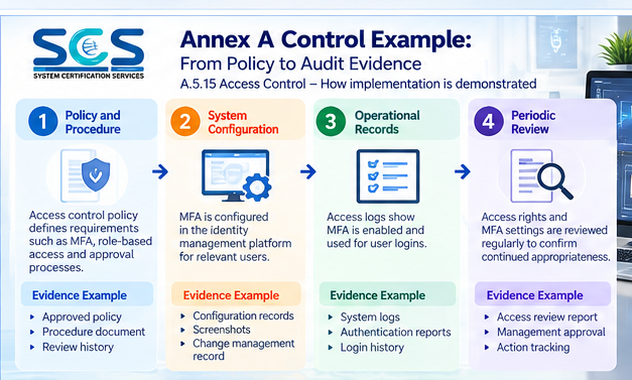
ISO 27001 Clauses 4 to 10: Evidence Examples
The following table maps common evidence to the main management-system clauses.
| ISO 27001 clause | Subject | Possible evidence |
|---|---|---|
| Clause 4 | Context of the organization | Context analysis, interested-party requirements, ISMS scope |
| Clause 5 | Leadership | Policy, responsibilities, leadership commitment |
| Clause 6 | Planning | Risks, opportunities, objectives, risk treatment plan, SoA |
| Clause 7 | Support | Resources, competence, awareness, communication, documented information |
| Clause 8 | Operation | Operational planning, risk assessment and treatment records |
| Clause 9 | Performance evaluation | Monitoring, measurement, internal audit and management review |
| Clause 10 | Improvement | Nonconformities, corrective actions and continual improvement records |
The exact evidence will differ between organizations.
A small professional-services firm may have a different set of systems, risks and records from a cloud provider or a technology company supporting government contracts.
For a broader explanation of the UAE certification requirements, refer to the ISO 27001 certification in UAE guide.
Annex A Controls: What Evidence May an Auditor Request?
Annex A provides a reference set of information-security controls. The organization determines applicable controls through its risk assessment and treatment process and documents its decisions in the Statement of Applicability.
Evidence should therefore be linked to the controls that apply to the organization.
| Control area | Illustrative evidence |
|---|---|
| Organizational controls | Policies, roles, supplier requirements, information-security procedures |
| People controls | Awareness, training, responsibilities and relevant personnel records |
| Physical controls | Visitor records, access arrangements and physical security checks |
| Technological controls | Access reports, system configuration, monitoring, backup and vulnerability records |
ISO 27001 Annex A evidence map covering organizational, people, physical and technological controls.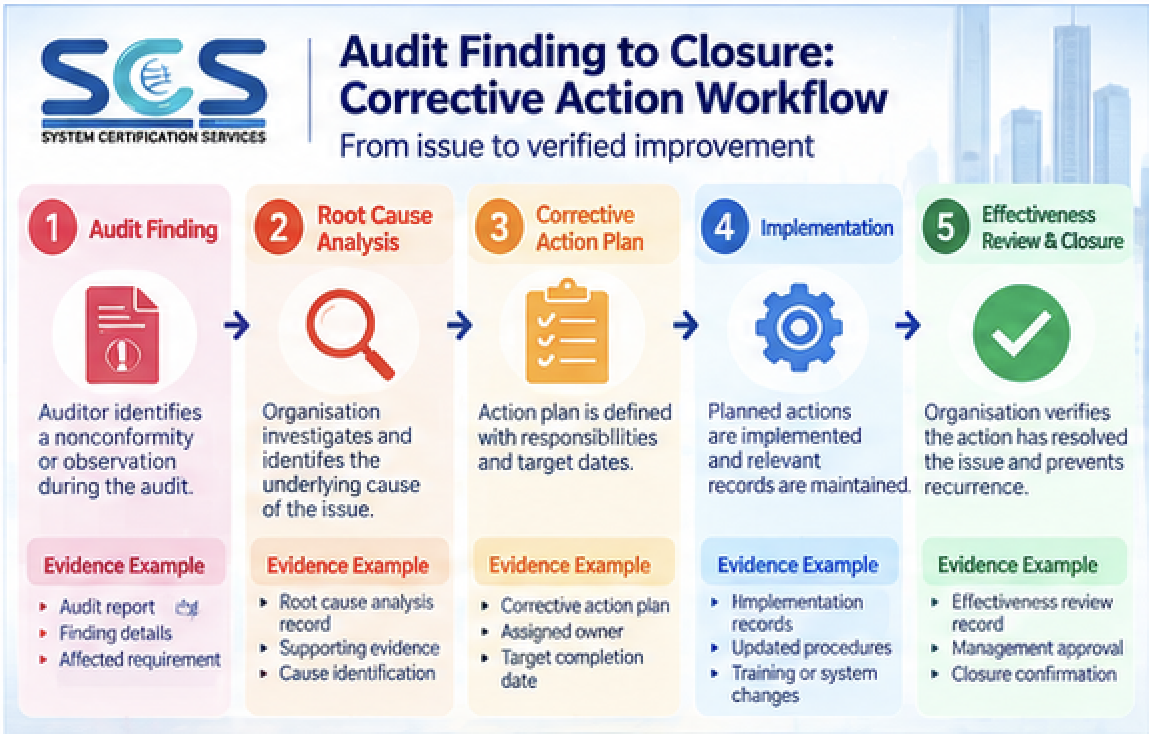
Stage 1 and Stage 2 Audit Evidence
ISO 27001 certification audits commonly involve Stage 1 and Stage 2 activities.
Stage 1 Audit
Stage 1 typically reviews the organization's ISMS documentation, scope, preparedness and relevant implementation arrangements.
Records that may be reviewed include:
-
ISMS scope
-
Information-security policy
-
Risk assessment methodology
-
Risk assessment results
-
Risk treatment plan
-
Statement of Applicability
-
Internal audit arrangements
-
Management review arrangements
-
Applicable documented information
The exact review depends on the certification audit programme and the organization's circumstances.
Stage 2 Audit
Stage 2 focuses on evaluating implementation and effectiveness of the ISMS against applicable requirements.
The auditor may sample operating evidence such as:
-
Access approvals and reviews
-
Training completion
-
Incident handling
-
Supplier reviews
-
Operational monitoring
-
Backup and recovery testing
-
Internal audit results
-
Management review actions
-
Corrective action effectiveness
The organization should be prepared to explain how its processes work and show relevant records.
For companies supplying government technology services, see the dedicated guide on ISO 27001 for UAE government IT suppliers and technology companies.
How to Organize ISO 27001 Audit Evidence
A clear evidence structure can save time during internal and certification audits.
One practical folder arrangement is:
ISO 27001 ISMS
-
01 — Context and Scope
-
02 — Leadership and Policy
-
03 — Risk Assessment and Treatment
-
04 — Statement of Applicability
-
05 — Competence and Awareness
-
06 — Operational Controls
-
07 — Access Management
-
08 — Incident Management
-
09 — Supplier Security
-
10 — Backup and Recovery
-
11 — Internal Audit
-
12 — Management Review
-
13 — Nonconformity and Corrective Action
-
14 — Monitoring and Improvement
Organizations may use a document management system, controlled shared drive or other suitable platform instead of physical folders.
A useful evidence register can include:
| Field | Purpose |
|---|---|
| Evidence reference | Unique record identifier |
| Clause or control | Related ISO 27001 requirement or applicable control |
| Evidence description | What the record demonstrates |
| Owner | Responsible department or person |
| Date or period | Relevant evidence timeframe |
| Status | Available, pending review or action required |
| Storage location | Controlled record location |
| Review date | When the evidence should next be reviewed, if applicable |
Example ISO 27001 ISMS evidence folder structure for organizing audit documentation and records.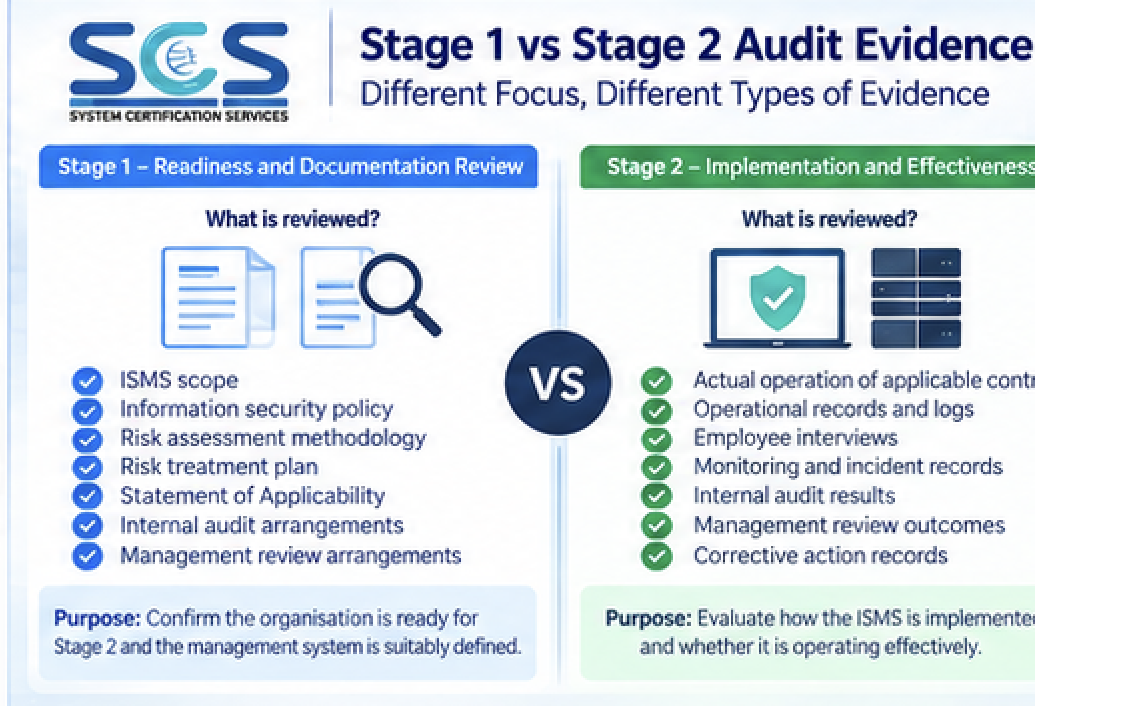
Common ISO 27001 Audit Evidence Gaps
Some issues arise because the organization has a documented process but cannot demonstrate its operation.
| Common gap | Why it matters | Practical action |
|---|---|---|
| Outdated risk register | May not reflect current risks | Review after relevant changes and at planned intervals |
| Missing access review records | Operation of access controls may be unclear | Retain completed reviews and actions |
| Generic SoA | May not reflect actual applicability decisions | Align it with the organization's risk treatment |
| Incomplete training records | Competence or awareness evidence may be insufficient | Maintain appropriate completion records |
| No restore-test evidence | Backup success may not demonstrate recoverability | Conduct and retain suitable recovery tests |
| Untracked audit findings | Improvement actions may remain unresolved | Assign owners and track closure |
| Missing management review actions | Decisions may not be followed through | Record responsibilities and progress |
| Uncontrolled documents | Staff may use outdated information | Apply suitable document control |
The solution is not to create paperwork solely for an auditor. Records should reflect real activities and help the organization manage information-security risks.
How Often Should ISO 27001 Evidence Be Updated?
There is no single update frequency that applies to every type of evidence.
The appropriate frequency depends on the requirement, risk, process, organizational changes and documented arrangements.
For example:
-
Access reviews may follow a defined periodic schedule.
-
Risk assessments may be revisited after significant changes or according to the organization's methodology.
-
Incident records are created when relevant incidents occur.
-
Internal audits follow the audit programme.
-
Management reviews follow planned arrangements and applicable requirements.
-
Supplier reviews may depend on supplier criticality and risk.
The organization should define suitable responsibilities and review arrangements, then retain evidence that those arrangements are followed.
How SCS Certification Can Support Your ISO 27001 Certification Journey
Organizations preparing for certification often need clarity on the audit process, certification scope, applicable requirements and evidence expected during assessment.
SCS Certification can discuss the certification process and audit arrangements based on your organization's activities and ISMS scope.
Organizations comparing certification providers can also refer to Top 10 ISO 27001 Certification Bodies in UAE.
Final Thoughts
ISO 27001 audit preparation becomes easier when evidence is organized around actual business processes rather than collected at the last minute.
A current risk register, an accurate Statement of Applicability, access records, incident handling evidence, internal audit results and management review actions can help demonstrate how the ISMS operates.
The objective is not to produce the largest possible document set. It is to maintain relevant, reliable records that support information-security management and can be explained during an audit.
For certification enquiries, visit the SCS ISO 27001 certification page.
Authoritative References
Need ISO 27001 Certification for Your Business?
Speak with our certification specialists to understand certification requirements, audit process, implementation timelines and accredited certification services.